

Impressive: Singapore Airlines Unveils New Cabins. Should Malaysians Make the Switch?
Singapore Airlines has finally unveiled its next-generation cabins, and there is plenty here for Malaysian premium travellers to get excited about.
Announced on 6 November 2026, the investment exceeds S$2 billion and covers 41 existing Airbus A350s and 31 incoming Boeing 777-9s. First Class introduces an impressive proposition for couples, while Business Class addresses several frustrations with SQ’s current long-haul seat.
Having already flown and reviewed both Japan Airlines’ A350-1000 Business Class and Cathay Pacific’s Aria Suite, I’m particularly interested in how this changes the competition.
After all, a new cabin needs to give us a reason to choose it. For Malaysians, that means considering the connection, the lounges, the redemption availability and, ultimately, how much spending it takes to accumulate the miles.
Let’s get into it.
Premium Cabins
First Class certainly looks the part.

The curved privacy doors, leather finishes, personal wardrobes and companion dining put this comfortably in the same luxury conversation as Emirates and Etihad’s premium First Class products, although their layouts and privacy arrangements differ.
The centre pair is the main attraction. Lower the divider and the two seats can become a sofa, before converting into a double bed measuring 80 inches long and 60 inches across.

Very Crazy Rich Asians. Unfortunately, Nick Young isn’t included to pay for the tickets.
However, combining two seats into a double bed is an established concept. Qatar Airways has offered this in selected Qsuite Business Class pairs for years, while SQ already offers double beds in its A380 Suites.

The appeal here is the execution: a fully retracting centre divider, a generous shared sleeping surface and the ability to dine together properly. For couples on a long overnight flight, that is considerably more useful than another decorative panel.
Just remember that the new First Class is planned for the A350 ULR and 777-9. The regular long-haul A350 will not receive it.
Business Class is where considerably more Refined Points readers will be looking. The seat looks good, and the improvements are practical. It reclines electronically into a bed, removing the current flip-over arrangement, while the redesigned footwell allows passengers to sleep straight rather than diagonally. Sliding doors, wireless charging and Bluetooth audio round out the proposition.

Eric Rosen’s coverage for The Points Guy highlights that change in bed conversion. It addresses a longstanding annoyance with SQ’s existing product.
However, the cabin looks a little more compact than I had expected.
The published 50-inch pitch deserves context:
Business Class product | Published seat width | Published pitch | Entertainment screen |
SQ new A350 long-haul/ULR | 22 inches | 50 inches | 22-inch 4K OLED |
SQ new Boeing 777-9 | 24 inches | 50 inches | 20-inch 4K |
JAL A350-1000 | 22 inches maximum | Approximately 51 inches | 24-inch 4K |
JAL’s published seat width is therefore the same as the new SQ A350 seat. Its pitch is only around one inch greater.
What matters is how comfortably you can move, lounge and sleep within that space. Pitch alone does not describe the bed or footwell in these interlocking layouts.
In my JAL A350-1000 review, I found the sleeping experience excellent. That experience was in bulkhead seat 8A, so my photographs should be read with that distinction in mind when comparing them with a standard SQ seat.

ANA’s original The Room is another useful benchmark, with a much broader, sofa-style seating area. SQ’s new seat does not appear to be pursuing that same lounging experience.
Executive Traveller’s David Flynn calls SQ’s design “exceptionally smart and considered” but also notes that side sleepers may still need to angle their knees on the mock-up. That is a useful qualification to the promise of sleeping straight.

As for Cathay Pacific, I remain very fond of Aria Suite.
Its restrained design, intuitive controls and comfortable bed impressed me when I flew it. The 24-inch 4K screen is also larger than either version of SQ’s new Business Class display, although SQ’s A350 OLED screen gives it a different technical advantage.

More importantly, Aria Suite is already flying. I can judge it from an actual journey, while SQ’s new seat still needs to prove itself through a full overnight flight.
Cathay’s catering remains a weakness, as I made clear in my review. Nevertheless, SQ’s announcement has given me a reason to try its new product; it has not automatically displaced Cathay as my preferred choice.
Economy Cabins
The distinction here is straightforward: the completely new Premium Economy and Economy seats are planned for the 777-9. The A350 cabins receive a refresh.
Premium Economy on the 777-9 gains 40 inches of pitch, compared with 38 inches on the current product, alongside updated seating and entertainment.

Economy adopts a 3-4-3 layout, with published seat width of 17.6 inches. Better screens and improved knee clearance are welcome, but ten-abreast seating deserves scrutiny.

For someone considering a paid Premium Economy ticket, the aircraft distinction matters. An A350 carrying the new Business Class does not automatically carry the new Premium Economy seat.
When Can Malaysians Actually Fly These Cabins?
SQ’s announced introduction window begins in the second half of 2027.
The inaugural aircraft, routes and flight numbers remain unannounced. Consequently, the following are routes to watch, rather than a deployment schedule:
Aircraft | Planned premium cabins | Routes I would watch |
34 long-haul A350s | 42 new Business Class seats; no First Class | High-profile long-haul services, with London and Sydney plausible candidates |
Seven A350 ULRs | Four First Class and 70 Business Class seats | Ultra-long-haul US services, particularly New York, given the aircraft’s existing role |
31 Boeing 777-9s on order | Six First Class and 54 Business Class seats | Major long-haul markets; individual assignments remain unconfirmed |
London and Sydney are sensible possibilities based on SQ’s history of showcasing flagship products. They remain forecasts.
Japan would be especially interesting for Malaysians, but deployment would require an eligible aircraft assignment. A regional A350 or 787 flight should not be assumed to receive these cabins.
My expectation is that competition for the first operating flights will be fierce, particularly for two or more Saver awards.
For a trip I actually wanted to enjoy, I would use 2028 as a more sensible planning year, allowing roughly six to twelve months after introduction on the chosen route. For multiple Saver seats, I would keep 2028 and 2029 open and retain alternatives.
There is encouraging news: Mainly Miles reports that SQ has no plans to restrict Saver awards specifically on the new seats.
Still, across the same 41 A350s, installed Business Class capacity increases from 1,897 to 1,918 seats after the full retrofit: approximately 1.1%. That calculation excludes incoming 777-9s and does not measure daily capacity or award allocation.
The A350 programme substantially improves the experience. It creates relatively little additional Business Class seating.
Which Malaysian Travellers Would Actually Switch?
The strength of SQ’s proposition depends heavily on where you are going.
Destination | Case for connecting through Singapore | Main consideration |
Australia and New Zealand | Singapore is a geographically sensible connecting hub, with a substantial onward network | Compare the complete journey with an MH nonstop and verify the actual cabin |
Japan and North Asia | A better cabin and Changi lounge experience may justify the connection | Travelling south before heading north adds time |
UK and Europe | Strong premium experience and nonstop services from Singapore to multiple European cities | MH’s Kuala Lumpur–London nonstop retains a meaningful convenience advantage |
North America | One connection through Singapore followed by a nonstop long-haul sector can be compelling | Compare total journey time and the specific US gateway |
Japan is where the comparison becomes particularly interesting.
Malaysia Airlines already operates its A330neo to Tokyo Narita, bringing privacy doors and fully flat Business Class seats to the nonstop option. If SQ eventually deploys its new cabin to Tokyo, the contest becomes much more credible than comparing a shiny new suite with an obviously dated MH seat.
Would I accept the connection? Potentially yes, particularly on an overnight itinerary with a sensible transit and an attractive fare or confirmed redemption.
The SilverKris Lounge at Changi Terminal 3 is also a substantial step above the underwhelming MH Regional Golden Lounge at KLIA. A proper meal, shower and comfortable break can make the connection enjoyable.

However, Cathay has an especially compelling answer for existing oneworld frequent flyers.
An eligible oneworld Emerald member flying Cathay can combine Aria Suite with access to lounges such as The Pier First in Hong Kong. On eligible departures from Haneda, JAL’s First Class Lounge adds another excellent ground experience.
Even without Emerald status, Cathay’s The Bridge helps make a Hong Kong connection attractive.
Those oneworld benefits do not carry across to an SQ booking. For someone who already holds valuable status, that can outweigh a modest difference between two excellent seats.
My criticism of Enrich as a miles accumulation strategy is separate from the value of its oneworld status benefits. You can be unimpressed with Enrich redemptions while still making excellent use of those benefits on Cathay and JAL.
For a fuller discussion of connection times and the complete itinerary, refer to my Singapore Airlines guide for Kuala Lumpur travellers.
KrisFlyer Miles in Malaysia: How Much Spending Does It Take?
This is where the launch becomes relevant to everyday decisions.
As I explained in my HLB Opus analysis, an impressive earning rate means little until you translate it into the spending required for a worthwhile redemption.
For planning, let’s use four representative Kuala Lumpur–Singapore–destination itineraries.
These are current Business Saver chart benchmarks per person, one way. They are planning scenarios, with actual pricing subject to routing rules and availability, not confirmed new-cabin routes or promised future redemption prices.
Destination via Singapore | Business Saver miles | Eligible spending from zero at 0.4 MPR | Additional spending when halfway there |
Tokyo | 57,000 | RM142,500 | RM71,250 |
Sydney | 75,500 | RM188,750 | RM94,375 |
London | 114,000 | RM285,000 | RM142,500 |
New York | 122,500 | RM306,250 | RM153,125 |
Equally weighted planning average | 92,250 | RM230,625 | Approximately RM115,313 |
“Halfway there” means already holding half the miles required for that particular target. The 92,250-mile figure is simply the average of these four examples. It provides a planning benchmark for this selection of destinations.
Why use 0.4 MPR? It is an accessible local earning reference through the Maybank KrisFlyer AMEX Platinum, assuming the spending qualifies and the merchant accepts American Express.
Take someone putting RM6,000 of eligible spending through that rate each month. They would earn 2,400 miles monthly.
The Tokyo target would take approximately 24 months from zero, or 12 months if already halfway there. At an actual blended earning rate of 0.8 MPR, those periods fall to approximately 12 and six months respectively.
Across the four-destination planning average, moving from 0.4 to 0.8 MPR halves the spending requirement from RM230,625 to approximately RM115,313.
Just remember the scale: a couple flying return to Tokyo at the illustrated Saver rate needs 228,000 miles. At 0.4 MPR, that represents RM570,000 of eligible spending. These calculations exclude welcome bonuses, transfer promotions, paid-flight mileage, taxes and fees, and small differences caused by earning and transfer rounding.
For Malaysians starting or refining a KrisFlyer strategy, these cards deserve consideration:
Credit card | Useful KrisFlyer earning rates | Minimum annual income |
0.4 MPR locally; 0.5 MPR on qualifying online spending | RM60,000 | |
0.41 MPR on qualifying local dining; 0.83 MPR overseas | RM120,000 | |
1 MPR on qualifying regional foreign spending in SGD, THB, VND and IDR; 0.83 MPR on other qualifying foreign spending | RM100,000 |
The UOB Visa Infinite dining bonus carries a RM1,000 monthly minimum condition. Both UOB cards have much weaker ordinary local earning, at approximately 0.08 MPR, so their overseas rates should never be applied to your entire household budget. Of course, I won't be discussing any detailed hacks and points arbitrage exploitations in a public forum, but that's where a subscription to my newsletter is useful 😉
Both UOB cards charge RM600 annually, with an annual spending requirement of RM50,000 for waiver. The Maybank card charges RM300, waived for the first year.
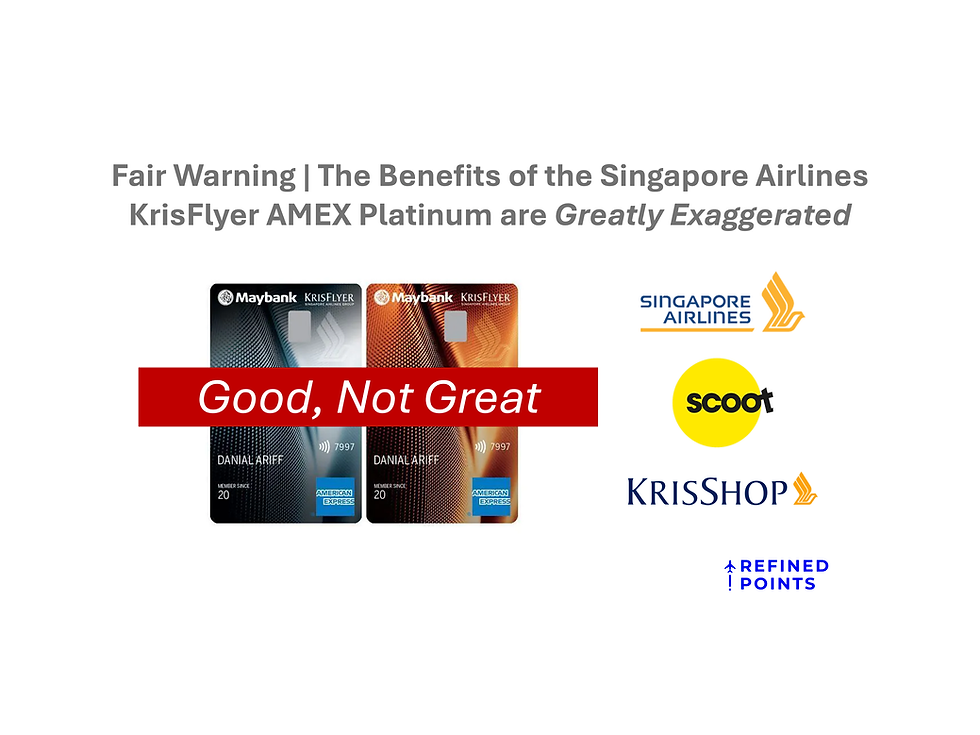
My UOB Visa Infinite review explains where that card works well. Likewise, read my assessment of the KrisFlyer AMEX Platinum’s limitations before assuming its airline branding makes it the obvious choice.
Existing premium or priority-banking cardholders should also compare their cards against the full Malaysian KrisFlyer earning guide.
My preference remains flexible bank points, within their expiry limits, until there is a credible redemption opportunity. A future cabin launch is a poor reason to transfer a large balance speculatively.
And if the desired SQ Saver seats are unavailable, search ANA and EVA Air through KrisFlyer before surrendering to an expensive alternative. Their partner inventory can also be scarce, and the aircraft matters: an ANA Kuala Lumpur–Tokyo award does not automatically mean The Room, nor does every EVA sector offer Royal Laurel.
For paid travel, compare the complete fare and itinerary before spending an excessive number of miles. When budgeting the hotel portion, Trip.com’s current offers are also worth checking against direct rates and the applicable booking conditions.
Final Thoughts
Singapore Airlines has given Malaysian travellers something worthwhile to plan towards.
The new First Class looks particularly appealing for couples. Business Class addresses practical weaknesses that have remained in SQ’s long-haul product for years, and the broader experience through Changi adds weight to the proposition.
However, I would still happily book Cathay’s Aria Suite or JAL’s A350-1000 when the itinerary, availability and price make sense. Both are excellent products, and an existing oneworld relationship gives them advantages that a new SQ seat cannot simply erase.
For newcomers, the useful action today is to improve how you earn and establish a realistic target. For readers already halfway there, the introduction window gives you time to build the remaining balance without forcing the spending.
I’m excited to try these cabins. I’m equally interested in seeing whether SQ can turn an impressive unveiling into flights that Malaysians can realistically book.

Comments