

The Real Value of HLB Opus’ 2.5 MPR
2.5 Miles per Ringgit is an extraordinary number. It is also, by itself, almost completely meaningless.
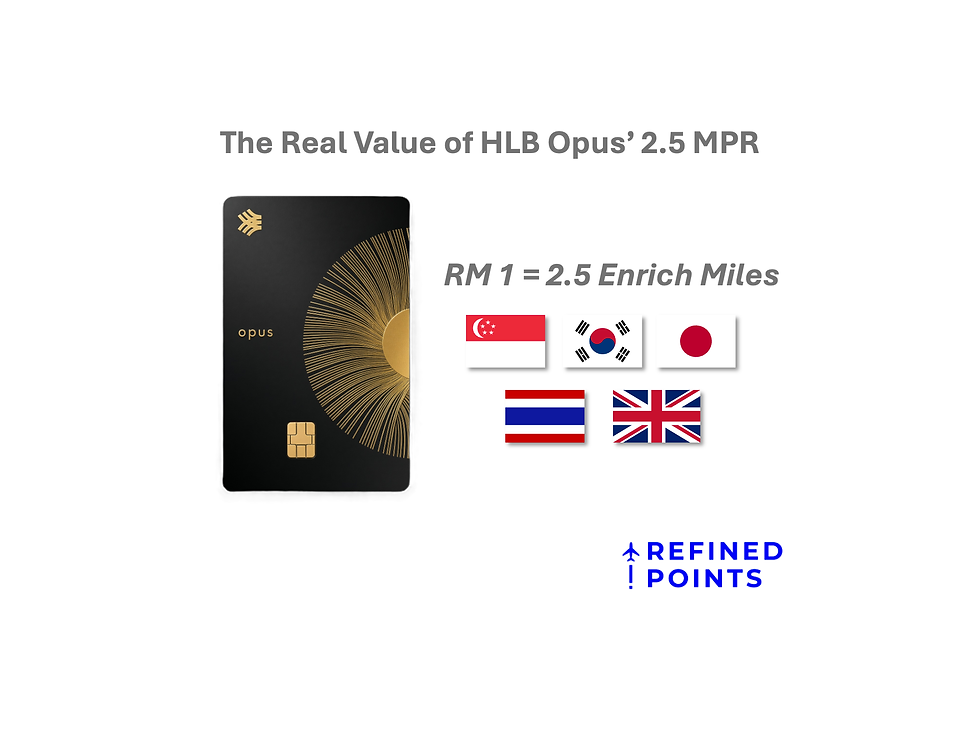
Since the launch of the HLB Opus Visa Infinite Privilege, which, let's be honest, 99% of us won't qualify for, much of the attention has understandably centred around its headline earn rate. Eligible transactions carrying the country code of Singapore, the United Kingdom, Japan, Thailand or South Korea earn an uncapped 2.5 Enrich Points per RM1, making this the highest headline airline miles earn rate currently offered by a Malaysian credit card.
Put 2.5 MPR beside the UOB Visa Infinite Metal Card’s 2 MPR or the Standard Chartered Beyond Visa Infinite Priority Private’s 2.14 MPR on overseas dining and shopping, and Hong Leong Bank appears to have comprehensively won the miles war.
Except airline miles do not work that way.
Miles per Ringgit only tells us how quickly a particular currency enters your account. It tells us nothing about how many of those miles an airline subsequently demands for a redemption, whether the award is actually available, how much you need to pay in taxes and surcharges, whether you are flying directly or connecting, or whether the Business Class seat you have spent months accumulating miles for is actually any good.
A card earning 2.5 MPR can therefore require more spending to obtain a particular Business Class redemption than another card earning 2 MPR if the latter programme charges substantially fewer miles for the same journey. Likewise, a seemingly enormous 25% MPR advantage can shrink into an almost irrelevant difference once the redemption side of the equation is considered.
This is what I want to explore in this article.
Instead of asking which credit card earns the most miles per Ringgit, we are going to ask a much simpler question:
How many Ringgit do I actually need to spend before those miles put me into the Business Class seat I want?
That distinction changes almost everything.

Wealthy Customers Absolutely Care About Miles
There is a strangely persistent belief that ultra-high-net-worth customers do not care about airline miles.
The argument usually rests on a simplistic assumption: if someone can afford to spend RM10,000 or RM20,000 on a Business Class ticket, they must therefore be indifferent to earning that same flight through points. Affordability, however, has absolutely nothing to do with whether someone values efficiency.
If affluent customers genuinely did not care about miles, banks would not be competing so aggressively on them at precisely the highest wealth tiers.
Hong Leong Bank has just launched a private-banking credit card offering up to 2.5 MPR. UOB’s Visa Infinite Metal earns 2 MPR overseas. Standard Chartered’s Beyond Visa Infinite Priority Private offers up to 2.14 MPR on overseas dining and shopping. These are not mass-market cashback cards designed to save someone RM20 on groceries. They are products built specifically for customers with substantial assets and spending power.

Banks are exceptionally disciplined when it comes to rewards costs. Airline miles represent a real liability, and no bank voluntarily gives away substantially more of them because it believes the target customer is indifferent. The existence of increasingly aggressive earn rates at the RM3 million wealth tier is itself evidence that affluent customers care about this proposition.
More importantly, being wealthy does not require someone to become financially irrational.
A person may be perfectly capable of purchasing a RM15,000 Business Class ticket while still preferring to redeem it using miles accumulated from spending that would have happened anyway. There is no contradiction between having money and caring about value. In many cases, the opposite is true.
The same logic applies outside airline miles. Wealthy clients negotiate mortgage rates, compare investment fees, optimise foreign-exchange spreads and scrutinise private-banking charges. Suggesting that they suddenly stop caring about efficiency when airline miles enter the conversation makes very little sense.
The relevant question is therefore not whether wealthy customers care about miles.
They do. The question is whether the HLB Opus is giving them the right miles.
The Great MPR Fallacy
Miles per Ringgit (MPR) tells you how fast you earn, not how far those miles will take you.
On Refined Points, we use MPR to compare earning rates across different loyalty programs. But here's the catch: a higher MPR doesn't always mean you'll reach your redemption goal faster. Why? Because different airline programs charge different amounts for the same seat.
Let's say you want Business Class. Programme A requires 100,000 miles and your card earns 2.5 MPR. That's RM40,000 in spending to get there.
Programme B needs only 70,000 miles for the same seat, but your card earns just 2 MPR. That's only RM35,000 in spending, which is RM5,000 less, despite earning 20% fewer miles per Ringgit.
So when is one MPR genuinely better than another?
Only when both cards earn the same airline currency and you're redeeming for the same thing. For example: HLB Opus (2.5 MPR) beats UOB Visa Infinite Metal (2 MPR) when both convert to Enrich and you're booking the same flight. Same currency, same redemption, higher earn rate. Simple.
The problem starts when you mix currencies.
Converting your UOB points to Asia Miles instead of Enrich means you're no longer comparing apples to apples. One Enrich Point doesn't equal one Asia Mile, which doesn't equal one KrisFlyer mile, which doesn't equal one Avios. Each currency gives you access to different airlines, different redemption rates, different availability, and different routing options.
Treating different airline currencies as interchangeable just because they're all called "miles" is one of the most common mistakes in points-chasing. The number matters far less than what that currency can actually buy.
A Simpler Way to Compare Airline Miles
I considered creating a fancy new metric for this, something like "Spend-per-Seat" with a colourful chart and a snappy acronym. But that would just add another thing to remember, and MPR is already confusing enough for newcomers.
Instead, we'll use a simple formula throughout this article: Miles required ÷ Miles earned per Ringgit = Spending needed
Example 1: Business Class costs 50,000 miles. Your card earns 2.5 MPR. 50,000 ÷ 2.5 = RM20,000
Example 2: Business Class costs 40,000 miles. Your card earns 2 MPR. 40,000 ÷ 2 = RM20,000
The first card looks better on paper (2.5 MPR vs 2 MPR), but both require exactly RM20,000 to reach your goal. The lower earning rate is offset by a lower redemption cost.

That is the comparison that matters. I'm walking through the basics here because it's easy to miss and even experienced miles enthusiasts benefit from revisiting the fundamentals when evaluating a new card or program.
Case Study 1: Kuala Lumpur to Tokyo
Tokyo is perhaps the perfect route for this analysis because it demonstrates both how good the HLB Opus can be and how quickly that advantage can disappear.
At the time of writing, Malaysia Airlines Enrich Saver Business Class between Kuala Lumpur and Tokyo can price at 52,000 Enrich Points one-way.
At 2.5 MPR on qualifying HLB Opus expenditure, you therefore need RM20,800 of eligible Opus expenditure to accumulate enough points for that redemption from zero.

If you used the UOB Visa Infinite Metal and converted its 2 MPR overseas earnings into Enrich instead, you'll need RM26k of spend overseas. HLB gets you onto exactly the same Malaysia Airlines flight after ~RM5,000 less spending. There is no complicated debate required here. Same airline, same redemption programme, same flight and same seat.
HLB wins.
Now Compare Singapore Airlines
Singapore Airlines Business Saver between Malaysia and Japan currently requires approximately 57,000 KrisFlyer miles one-way.
Using UOB Visa Infinite Metal at 2 MPR, that's RM28,500 in total overseas spend required. That is considerably more spending than the RM20,000 required to reach a 52,000-point Enrich Saver redemption through HLB Opus. On accumulation mathematics alone, Malaysia Airlines wins easily.
There is also the routing issue. Malaysia Airlines flies directly between Kuala Lumpur and Tokyo, while Singapore Airlines requires you to fly south to Singapore before heading north again towards Japan.
This adds a connection, additional flying time and another opportunity for something to go wrong. If your objective is simply to travel from Kuala Lumpur to Tokyo in Business Class efficiently, it would be intellectually dishonest to pretend KrisFlyer is superior here purely because Singapore Airlines has the better brand. At 52,000 Enrich Points, HLB Opus is exceptionally difficult to beat.
What About Cathay Pacific?
Cathay Pacific introduces a different proposition. A Business Class award from Kuala Lumpur to Tokyo via Hong Kong can fall around the 60,000 Asia Miles level depending on the applicable itinerary and award pricing.

At 2 MPR through UOB obtaining a 60K Asia Miles redemption would required a total overseas spend of RM30,000. Again, HLB wins comfortably against a 52,000-point Enrich Saver redemption requiring just RM20,800 of qualifying spending. Purely on the numbers, if an Enrich Saver seat exists, this is not close.
Then Enrich Saver Disappears
This is where the entire argument changes. Malaysia Airlines operates dynamic award pricing alongside its Saver inventory. I have previously seen one-way Business Class redemptions to Tokyo priced at approximately 130,000 Enrich Points for Business Basic, and up to over 269,700 Enrich Points for Business Flex when the 52,000-point Saver award was unavailable!
The HLB Opus still earns exactly the same 2.5 MPR. But now: 269,700 ÷ 2.5 = RM107,880! The exact same credit card suddenly requires RM108K of qualifying spending before you have enough Enrich Points for the available redemption.

Meanwhile, Cathay Pacific comes in again at approximately 60,000 Asia Miles: RM30K spending at 2 MPR with the UOB Visa Infinite Metal Card. For the exact same date as the above example, there are tons of options available, many with very realistic 2-3 hour stopovers.
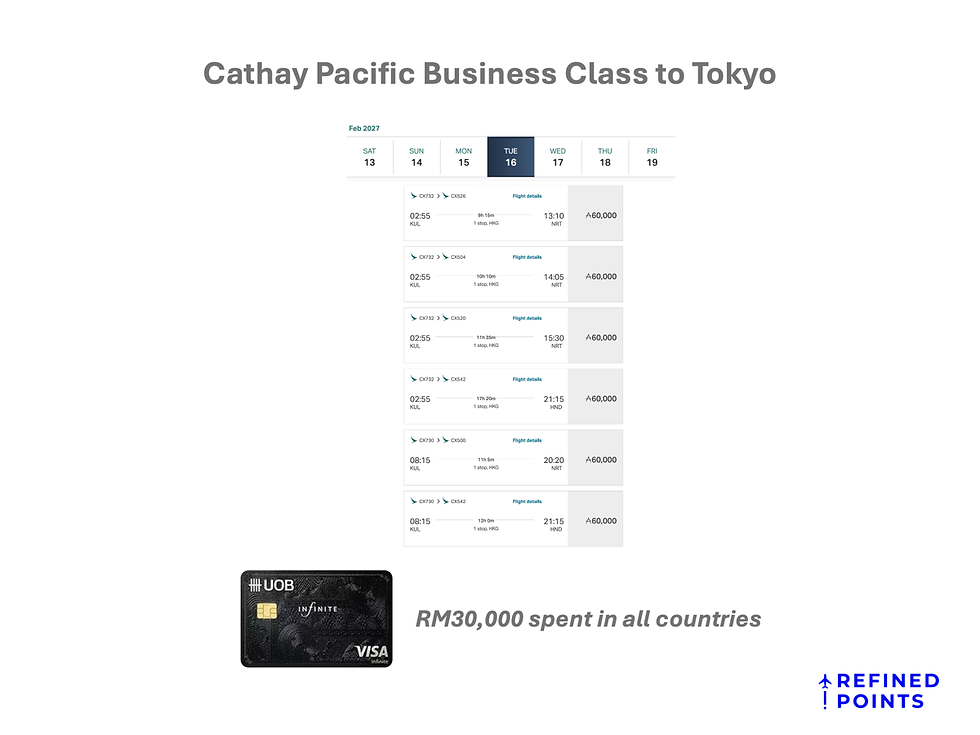
The 2.5 MPR headline has not changed. The card has not been devalued. Hong Leong Bank has not changed a single line of its Terms and Conditions. Yet the amount of spending required to obtain your Business Class redemption has more than doubled because the airline controlling the redemption side of the equation changed the price.
Malaysia Airlines hardcore fanboys may counter that Oneworld flights are also available for redemption through Enrich Miles. However, this argument does not strengthen their position.

On the same date, redeeming Malaysia Airlines Enrich Miles for equivalent Oneworld services such as Cathay Pacific flights to Tokyo requires a significantly higher threshold of 82,000 points. This pricing structure undermines the value proposition they are attempting to defend.
This is the single biggest weakness in treating MPR as the final measure of credit card value.
Theoretical Value Is Not the Same as Available Value
Award charts tell you how much a redemption can cost while availability tells you what it costs you. There is an enormous difference.
Knowing that Tokyo can be redeemed for 52,000 Enrich Points is useful if a 52,000-point seat actually exists on the date you need. If the only available option is 130K Enrich points, then your real decision is between:
130K Enrich Points
57,000 KrisFlyer miles
60,000 Asia Miles
The theoretical Saver chart is no longer relevant to your holiday and this becomes particularly important for families looking to redeem more than 2 business class seats. Finding one Business Class award seat is relatively easy but finding four seats during the December school holidays is a completely different sport.
An HLB Opus cardholder may accumulate Enrich significantly faster, but that advantage provides little comfort if Malaysia Airlines will only release one Saver seat while another programme provides four seats at a different price.
But Which Business Class Are You Actually Buying?
The Tokyo comparison also exposes another weakness in purely mathematical analysis. Even if two programmes required exactly the same amount of credit card spending, they would not necessarily deliver equivalent outcomes.
Malaysia Airlines, Singapore Airlines and Cathay Pacific all sell something called Business Class.
That does not make those products identical.
Malaysia Airlines deserves considerably more credit today than it did several years ago because its A330-900neo finally gives the airline a genuinely modern Business Class product, with fully flat seats, direct aisle access and greater privacy.

If you manage to pair the HLB Opus’ 2.5 MPR earn rate with a 52,000-point Enrich Saver redemption on an A330neo to Tokyo, the entire proposition makes a tremendous amount of sense.
However, Singapore Airlines and Cathay Pacific remain substantially stronger premium ecosystems overall. Singapore Airlines generally provides a more polished service experience and considerably stronger consistency across catering, crew service and the wider journey through Changi. Even the SilverKris Lounge (which is Singapore Airlines' Business Class lounge) blows the Platinum Lounge at KLIA out of the water.

Cathay Pacific can provide excellent long-haul Business Class products, including its newer Aria Suite, while Hong Kong remains one of the strongest airport ecosystems in the world for premium oneworld travellers.
And then there are the lounges. I've written extensively on Cathay Pacific lounges, particularly The Pier First, which is considered amongst the best in the world. Hilariously enough, this seems to be one thing Malaysia Airlines fanboys agree with me on!

To put things simply, a Business Class redemption does not merely purchase a seat between two cities. It also buys the ground experience attached to the ticket. At Hong Kong, Cathay Pacific operates some of the best airline lounges in Asia. Likewise, at Singapore, Singapore Airlines’ SilverKris lounges form part of a much broader premium hub experience.
Malaysia Airlines' Golden Lounge at KLIA has improved in certain respects, but I do not think anyone seriously comparing the overall premium experience would place it ahead of Cathay Pacific’s flagship Hong Kong lounges.

This is important because miles are ultimately a consumption currency. The objective is not to possess 52,000 points. The objective is to exchange those points for an experience.
Case Study 2: Kuala Lumpur to London
London produces a much more interesting result because this is where HLB’s enormous headline advantage can almost disappear. A Malaysia Airlines Enrich Saver Business Class redemption between Kuala Lumpur and London can require 108,000 Enrich Points one-way.
Using HLB Opus at 2.5 MPR: 108,000 ÷ 2.5 = RM43,200. That is a respectable amount of credit card expenditure for a nonstop long-haul Business Class redemption.

Singapore Airlines Business Saver from Malaysia to Europe requires a larger KrisFlyer balance than the Malaysia Airlines Enrich Saver example above, meaning HLB can retain a substantial advantage in the amount of spending needed to accumulate the award.
But once again, we are no longer buying identical products. Malaysia Airlines offers the convenience of a nonstop service from Kuala Lumpur. Singapore Airlines requires a connection in Singapore but provides access to a substantially different premium ecosystem.
Whether that difference is worth additional miles is a personal decision. What is not a personal decision is the mathematics. We can calculate exactly how much more spending is required.
Award Availability Is Exactly Why Flexibility Matters
Neither Singapore Airlines nor Cathay Pacific award seats are guaranteed. Singapore Saver can vanish quickly on contested routes, leaving pricier Advantage or Access pricing. Cathay faces similar scarcity for multiple seats.
This isn't an argument that Enrich has bad availability, so transfer everything elsewhere. The real advantage of flexible points is having somewhere else to look, not a guarantee of cheap seats.
Say you want four Business seats to Tokyo next December. If all your points sit in Enrich and Saver is gone, your search ends there. If they sit with UOB instead, you can check KrisFlyer, then Asia Miles, then a different date. You pivot until something works.

This matters because KrisFlyer and Asia Miles unlock far broader networks than their home carriers, Asia Miles into Japan Airlines, Qatar Airways and Qantas; KrisFlyer into ANA, Thai Airways and EVA Air, mostly bookable online.
Yes, Enrich technically allows oneworld redemptions too, but having access and having useful access are different things. Enrich's partner pricing is often so inflated that premium redemptions border on parody. Telling an HLB Opus cardholder that Enrich is "fine because you can redeem on Cathay or Qatar anyway" misses the point. Of course you can. The question is whether anyone rational should.
This is why locking 2.5 MPR into Enrich bothers me more than the headline rate suggests. Hong Leong built a fast way to earn a currency whose best use cases centre on Malaysia Airlines itself. Once Malaysia Airlines stops offering value, the escape routes are far worse than they look. For a card charging RM3,000 a year, that's not a minor inconvenience. It's a fundamental flaw.
Why UOB and Standard Chartered Remain Far Stronger for Global Miles
This is ultimately where both the UOB Visa Infinite Metal and Standard Chartered Beyond Visa Infinite Priority Private separate themselves from the HLB Opus.
An ultra-high-net-worth traveller may spend one month in Japan, the next in France, travel to Switzerland for business, visit family in Australia and then spend Christmas in New York. A genuinely premium overseas rewards proposition should follow the cardholder around the world rather than become dramatically weaker the moment the aircraft lands somewhere outside a predetermined corridor.
The UOB Visa Infinite Metal does exactly that. Eligible foreign-currency expenditure earns 2 MPR globally, which means I do not particularly care whether I am paying for dinner in Tokyo, shopping in Paris or checking out of a hotel in Sydney. More importantly, those points remain flexible until I decide whether Enrich, KrisFlyer or Asia Miles provides the best redemption.

Standard Chartered takes a slightly different approach with the Beyond Visa Infinite Priority Private. Overseas dining and shopping earn up to 2.14 MPR, while other eligible overseas expenditure continues earning 1.42 MPR. Again, the headline peak is lower than HLB's 2.5 MPR, but the proposition travels far better.
UOB remains my clear preference from a pure airline miles perspective. Yes, the RM3,000 annual fee is painful, but HLB charges exactly the same principal annual fee while offering substantially less flexibility. If I am already accepting a RM3,000 cash outflow, I would much rather earn 2 MPR globally and decide between Enrich, KrisFlyer and Asia Miles later.
HLB Opus Is an Excellent Relationship Card, but a Weak Acquisition Proposition
If you already hold an HLB Private Bank relationship, keep the required assets there, and are receiving the Opus anyway, the card is easy to appreciate. You get a spectacular ceramic card, Plaza Premium First, a strong 2.5 MPR accelerator across five markets, and Visa Infinite Privilege benefits, all layered onto a relationship you already have. Viewed that way, I like the card considerably more.

Hong Leong doesn't need every Opus holder to restructure their entire miles strategy around Enrich. It needs the card to make an existing Private Bank relationship feel more valuable and capture more wallet share from customers already in its ecosystem. That's classic ETB strategy, and the Opus executes it well.
The problem is whether the card is compelling enough to pull new-to-bank customers away from competing private banks. Imagine you have RM3 million with Standard Chartered Priority Private, or you're comfortable with UOB's Visa Infinite Metal ecosystem. Moving a private-banking relationship is far more complex than applying for a credit card, given the portfolios, relationship managers, financing arrangements and preferential rates involved. A five-country 2.5 MPR accelerator tied exclusively to Enrich isn't a strong enough reason to move.

The Opus is also difficult to justify as an acquisition product because its best feature is situational. Spend in Japan, Singapore, Thailand, South Korea or the UK and it shines. Spend anywhere else and the value drops sharply. That's a minor issue for existing HLB clients, who can simply use the card when circumstances favour it. For new-to-bank customers, Hong Leong is competing against products with much broader miles propositions, and a beautiful card doesn't close that gap.
The Opus, then, is best understood as a card that makes existing HLB Private Bank clients happier to stay. Whether it convinces someone else's private-banking client to switch is a different question entirely.
Final Thoughts
The HLB Opus Visa Infinite Privilege has done something genuinely useful for Malaysia’s miles market: it has forced us to confront just how little a headline MPR tells us about the eventual value of a credit card.
There is no question that 2.5 MPR is spectacular. If I knew I was about to spend RM30,000 in Japan, the transaction qualified for the accelerator and I already had a sensible Enrich redemption in mind, I would have absolutely no hesitation using the Opus. There are circumstances where the card is genuinely exceptional, and pretending otherwise simply because I dislike being locked into Enrich would be equally poor analysis.
But those circumstances need to align remarkably well. You need to spend in one of HLB’s five qualifying country codes. You need to be comfortable accumulating Enrich Points. You need Malaysia Airlines to release an award at a sensible price. You ideally need the airline to operate a product you actually want to fly, and your travel plans need to remain reasonably close to what you had anticipated when those points were earned.
That is a lot of conditions attached to what initially looks like a very simple “2.5 MPR” proposition. The case studies also deliberately give the HLB Opus the most favourable possible environment: we are comparing hypothetical qualifying overseas expenditure as though every Ringgit the cardholder spends earns 2.5 MPR. Real life obviously does not work that way.
Practically everyone spends considerably more money at home than they do overseas. Even among affluent Malaysians who travel frequently, there are still mortgages, insurance premiums, school fees, dining, groceries, medical expenditure, subscriptions, shopping and every other ordinary component of life taking place in Malaysia.
Most people are not spending twelve months of the year walking around Ginza, Orchard Road and Knightsbridge with an Opus card in hand.
This matters because the enormous 25% headline advantage over UOB’s 2 MPR only exists on the portion of your annual expenditure that actually qualifies for HLB’s five-country accelerator.
Spend RM100,000 overseas exclusively across Japan, Singapore, Thailand, South Korea and the United Kingdom and the 2.5 MPR headline becomes highly consequential. Spend RM20,000 across those countries while another RM100,000 of your annual card expenditure takes place in Malaysia, and that headline suddenly describes only a small fraction of your actual wallet.
That does not make the Opus useless locally. Its 1 MPR dining rate remains excellent, while travel and retail earn approximately 0.33 MPR and other eligible expenditure earns 0.2 MPR. The point is simply that nobody should extrapolate a specialised 2.5 MPR overseas accelerator into an assumption that the Opus is somehow generating 25% more airline miles than the UOB Visa Infinite Metal across an entire year.
And the biggest weakness remains Enrich.
A 52,000-point Enrich Saver redemption to Tokyo can be excellent. I have no issue saying that. If the seat exists, the aircraft is right and the schedule works, the HLB Opus can get you there extraordinarily quickly.
The problem begins when that redemption disappears. Malaysia Airlines can replace sensible Saver pricing with dramatically higher dynamic pricing, and Enrich’s supposed escape route into oneworld is nowhere near as reassuring as some people like to pretend.
Yes, Enrich can technically book Cathay Pacific, Japan Airlines, Qatar Airways and other oneworld carriers. Some of those partner awards are also priced at levels so outrageous that describing them as useful alternatives requires a heroic suspension of disbelief.
Asia Miles gives me a credible oneworld ecosystem. KrisFlyer gives me a credible Star Alliance ecosystem. Enrich gives me Malaysia Airlines first and an often brutally priced collection of partner awards afterwards.
Fairly enough, KrisFlyer is hardly perfect either. Singapore Airlines Saver awards can disappear almost immediately on heavily contested dates, leaving Advantage awards or considerably more expensive Access pricing. Cathay Pacific can also suffer from poor award availability, particularly when several Business Class seats are required.
But that actually strengthens the case for flexible bank points rather than weakening it. The point of holding UOB points is not that KrisFlyer will always beat Enrich, but that I can check Enrich, KrisFlyer and Asia Miles before deciding.
Travel plans change constantly, and award availability changes even faster. The destination you expected to visit next year may not be the destination you eventually book, while the airline programme offering fantastic availability today may be completely useless by the time your family settles on its travel dates.
The UOB Visa Infinite Metal remains, in my view, comfortably superior to the HLB Opus as an airline miles credit card despite both charging the same RM3,000 annual fee. Its 2 MPR overseas rate is lower, but eligible foreign-currency spending earns that rate globally rather than within five country codes, and its points can ultimately become Enrich, KrisFlyer or Asia Miles.
I would willingly sacrifice 0.5 MPR for that flexibility.
The Standard Chartered Beyond Visa Infinite Priority Private makes a similarly compelling case for the globally mobile affluent customer. Its 2.14 MPR rate on overseas dining and shopping does not beat HLB’s peak, but it follows you far more naturally around the world, while other overseas expenditure continues earning at a respectable rate and the underlying rewards structure leaves considerably more room to decide how those points should eventually be used.
This is particularly important when we return to the actual target market. HLB Opus is not aimed at someone earning RM60,000 a year and taking one annual holiday to Bangkok. It sits inside a private-banking proposition for customers with substantial assets, precisely the sort of people most likely to have highly international spending patterns and travel plans that extend well beyond five selected countries.
For an existing HLB Private Bank customer, that does not particularly bother me. You already have the relationship, so take the Opus, enjoy the ceramic card, use 2.5 MPR aggressively whenever the right opportunity appears and extract every last bit of value from the benefits Hong Leong Bank is giving you.
As an ETB proposition, the card makes sense, but as a reason for someone sitting in another private bank to move millions of Ringgit into HLB, it is nowhere near persuasive enough.
If I were already with UOB, I would much rather retain a globally consistent 2 MPR card with three airline programmes. If I were already a Standard Chartered Priority Private customer, I would much rather retain a genuinely global overseas earn structure and a flexible rewards ecosystem. I certainly would not uproot a private-banking relationship because Hong Leong Bank offered me another 0.36 or 0.5 MPR in five countries and then told me every mile had to become Enrich.
And once we remember that most of our actual annual spending happens locally rather than inside an imaginary twelve-month overseas-spend spreadsheet, the importance of HLB’s 2.5 MPR headline shrinks even further. This is of course where the real "hacks" come in, and is probably why ShopeePay is likely to continue winning favours for miles enthusiasts. IYKYK ;)
Having the greatest probability of converting the money you were already going to spend into the premium flight you actually want is the real luxury. HLB gives you more Enrich Points. UOB and Standard Chartered give you more ways to get home.


For someone working in UK, would getting this card be worth it? Quals. aside
The 2.5 MPR only matters if you’re already parked at HLB and happy redeeming Enrich. The private bank itself is still being built in public...Lombard Odier views, a Singapore office, portfolio lending, and two private markets funds that only showed up in July. Maybank is already doing actual family office work, while UOB and StanChart will take the same RM3m, lend against it properly, and let you sit on flexible points. Nobody at that ticket size moves an AUM relationship for a five-country ISO spend accelerator. If you wouldn’t park the capital there for the advisory shelf, a ceramic card doesn’t fix it
I think pre-emptively accusing anyone that takes a different view to you a 'MAS fanboy' is a bit pathetic from what has historically been a very good blog. The unnecessary personality politics and the creeping use of AI imagery really degrades the product.
Great article, also just to note with 10-20% enrich bonus usually twice a year, it gets closer to 2.5 MPR for the other cards