

Review | Cathay Pacific’s Brand-New Aria Suite Business Class

Cathay Pacific has long been one of my favourite airlines in the world, largely due to its consistently polished service and some of the best lounges you’ll find anywhere, particularly at Hong Kong International Airport and London Heathrow.
When Cathay Pacific first announced that it would be retrofitting its Boeing 777-300ER fleet with an all-new Business Class product two years ago, I knew this was something I had to experience firsthand.
Award availability on Aria Suite–equipped routes has been notoriously tight, but I managed to snag a last-minute redemption from Frankfurt to Hong Kong for 88,000 Asia Miles.
I’ll cover redemption strategies later in this article, but for now, let’s dive into how this much-hyped seat stacks up against the competition.
Boarding at Frankfurt

Boarding began exactly on schedule at Frankfurt Terminal 2, and I was among the first to step onboard thanks to my Enrich Platinum status, which grants Oneworld Emerald (First Class) privileges despite flying on a Business Class ticket.

The priority boarding process was smooth and efficient, setting a positive tone for the flight ahead.
Aircraft and Seat
Cathay Pacific’s Aria Suite is installed on select Boeing 777-300ER aircraft following an extensive cabin retrofit, and the difference is immediately apparent the moment you step onboard.

The cabin feels modern, refined, and unmistakably Cathay, with a calming palette of soft greys, muted greens, and warm wood accents that elevate the space without feeling flashy.
The galleys are noticeably more spacious and thoughtfully laid out compared to the older Cathay Business Class cabins, helping minimise congestion during meal services and reducing noise spill into the cabin. This may sound trivial, but on a long-haul flight, these details matter more than most airlines realise.

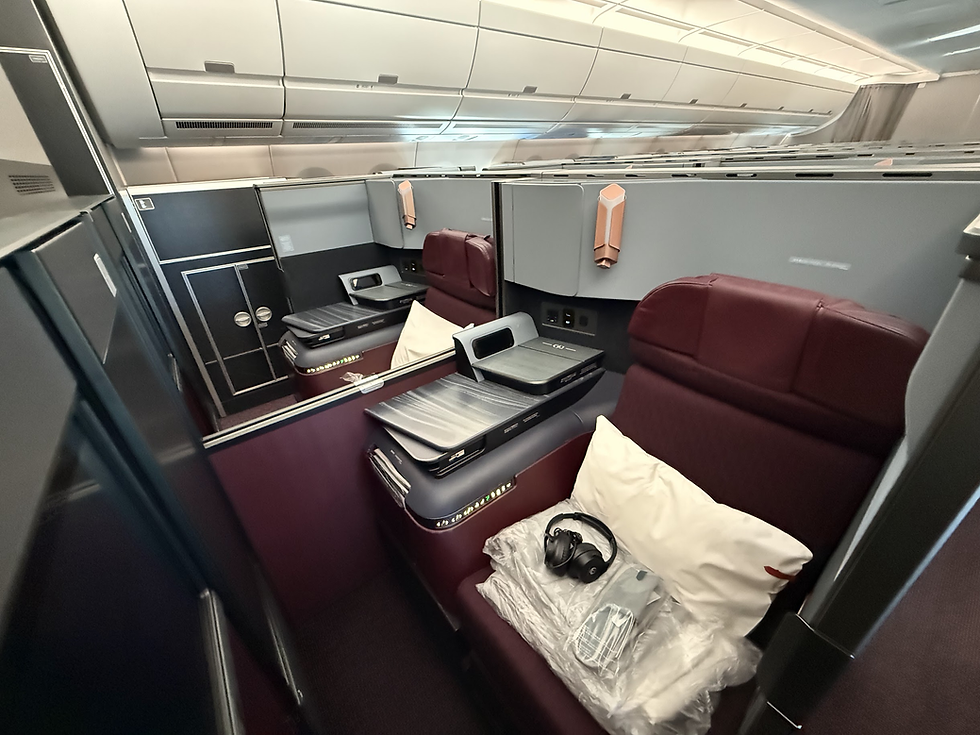
The Aria Suite itself is arranged in a 1-2-1 configuration, offering direct aisle access for every passenger. Each seat is fully enclosed with a sliding door, providing a high level of privacy without feeling claustrophobic.

Cathay has struck a good balance here—the suite walls are high enough to create a genuinely private space, yet open enough to maintain a sense of cabin cohesion.


Seat controls are intuitive and responsive, with multiple preset positions alongside fine-grain adjustments. I can't tell you enough how much I love this seat control touchscreen. It was amazingly intuitive.

The seat transitions smoothly into a fully flat bed, which is both wide and well-supported. Sleeping comfort is excellent, and the bedding provided is plush enough to rival some First Class products from just a few years ago.

The entertainment screen is large, crisp, and positioned at an optimal viewing distance, making it easy to watch content even while lying flat. For comparison, here's how it looks like compared to my 11-inch iPad Air.


Storage has also been well thought out, with compartments for shoes, headphones, smaller personal items, and ample counter space for drinks and devices. I did find this "shoe compartment" to be a little on the small side, and it couldn't fit my On Clouds.


WiFi was available throughout the flight and performed reliably for messaging and light browsing, although it’s still not at a level where you’d want to get serious work done.
The tray table is solid and easy to deploy, sliding out smoothly and offering plenty of space for dining without feeling flimsy or awkward.


A glass of champagne was offered shortly after settling into my seat, which I gladly accepted.

Amenity kits are supplied by Bamford, containing a well-curated selection of skincare essentials. It’s understated rather than extravagant, but very much in line with Cathay’s quiet-luxury philosophy.


The lavatories deserve a special mention too—they’re noticeably larger than those on older Cathay 777s, kept impeccably clean throughout the flight, and stocked with Bamford amenities as well.


Food & Beverage
A few days before departure, I had the option to pre-select my meal via Cathay Pacific’s website. However, this was limited to choosing from the standard onboard menu rather than a true pre-order concept like Singapore Airlines’ Book the Cook. I’m aware that Cathay does offer more elevated pre-order dining on certain routes, such as London–Hong Kong, so this appears to be highly dependent on catering location.
I began with a cauliflower and almond soup, which was genuinely enjoyable, although I didn't like how the amuse-bouche was serve alongside as a "side" rather than at the beginning. It feels too rushed for my liking.

For my main course, I opted for the wok-fried cod fish with supreme soy sauce, served with jasmine rice and soup. This is a classic Chinese dish and an easy choice over the German slow-cooked marinated beef or Arabic-spiced chicken with black lime.


While the dish was tasty, it lacked the sense of exclusivity and refinement that Cathay sometimes delivers on its flagship routes, particularly those catered in collaboration with Duddell’s. It was also nowhere near the level of quality I experienced on Japan Airlines’ A350-1000 Business Class from Tokyo to London.
This continues to be Cathay Pacific’s weakest link. Despite offering one of the most impressive Business Class seats in the sky, the onboard dining experience often feels like an afterthought. Presentation and menu creativity lag behind competitors, even if flavours remain decent and well-suited to Asian palates.
One could argue that Cathay assumes premium passengers have already dined in its excellent lounges prior to departure—and while there may be some truth to that—the gap is simply too wide to ignore. That said, the food is still comfortably better than what Malaysia Airlines serves across its network, earning what I’d describe as the gold standard of cheapskate airplane food.
Dessert was a lemon curd with almond crumble and meringue, which was excellent and easily the highlight of the meal.

On the beverage front, I browsed the wine list ahead of time and even looked up a few labels on Vivino, but nothing stood out as particularly exciting. I sampled the Grant Burge Filsell Shiraz from Barossa Valley, which was pleasant but unremarkable.
What I did indulge in—perhaps a little too enthusiastically—was Cathay Delight. I had more than five glasses, much to my blood sugar’s dismay. It remains, in my opinion, the best non-alcoholic beverage ever served onboard an aircraft, and I’m delighted (no pun intended) that it’s also available in Cathay’s lounges on the ground.
Breakfast, however, was a complete mess.
I hadn’t pre-ordered breakfast, nor was I approached by any flight attendant prior to service. Instead, a tray of items I clearly did not request was placed in front of me. An acai superfood bowl. Seriously?

I immediately raised the issue with the cabin crew and explained that I had not ordered this and wanted the Chinese breakfast instead. Thankfully, there were still portions available, but this felt like an unusually sloppy oversight for Cathay Pacific. On a fuller flight, this could have ended far worse—especially if the passenger involved happened to be a Cathay Diamond member.
The Chinese breakfast itself was equally uninspiring. Congee with fried noodles and bread on the side. Cathay serves congee even in Economy Class, and while it’s tasty, it’s hardly premium. Compared to breakfast offerings on Qatar Airways or even Singapore Airlines Business Class, this felt disappointing.

Unsurprisingly, it wasn’t filling enough, and I ended up ordering a side of flat rice noodles with fishball soup from the all-day menu, which was excellent and easily redeemed the situation.

Full Menu
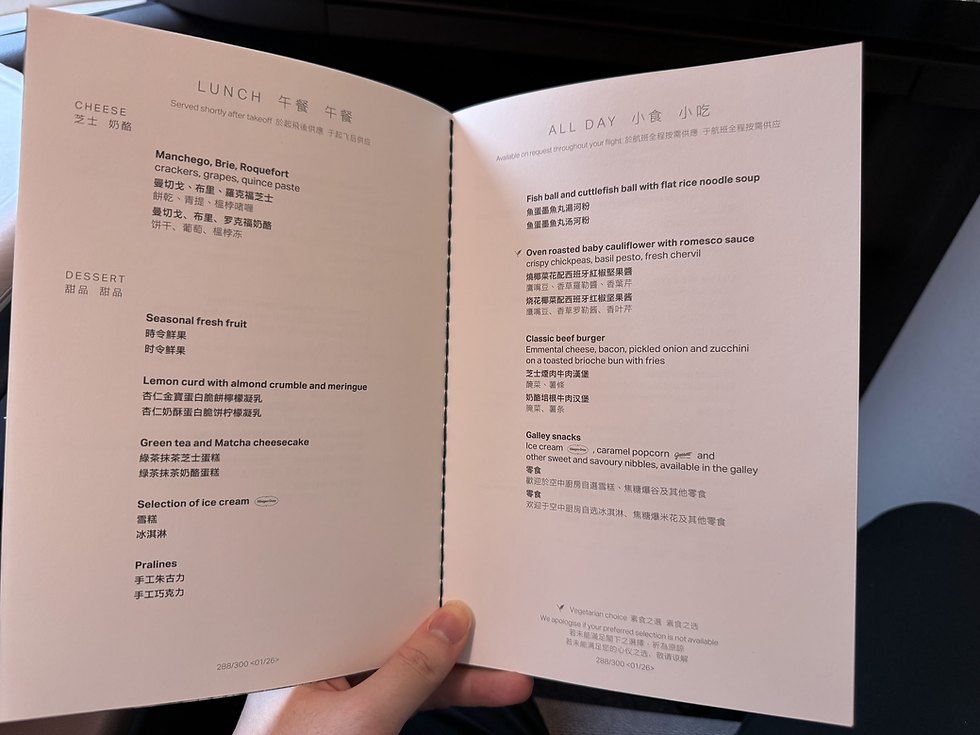
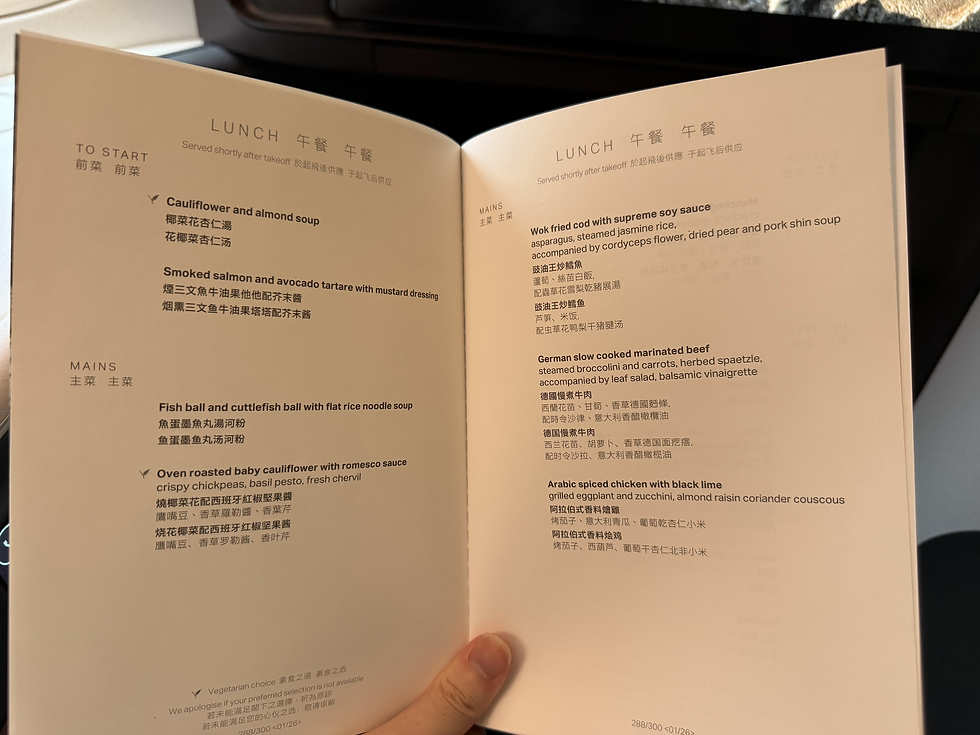


Redeeming Aria Suite with Asia Miles
Unlike Japan Airlines’ A350-1000 Business Class, which can be inconvenient to plan around due to Tokyo being out of the way for many Malaysians, Cathay Pacific’s Aria Suite is far more accessible with the right strategy.
As of January 2026, Cathay Pacific operates its retrofitted Boeing 777-300ER aircraft with Aria Suites on the following routes:
London (LHR) – CX255 / CX250 – Daily
Frankfurt (FRA) – CX289 / CX288 – Daily
San Francisco (SFO) – CX872 / CX873 – Daily
Milan (MXP) – CX233 / CX234 – 3x Weekly
Tokyo (HND) – CX549 / CX548 – Daily
Vancouver (YVR) – CX888 / CX865 – Daily
Sydney (SYD) – CX161 / CX162 – High Frequency
Melbourne (MEL) – CX163 / CX178 – Ongoing
Beijing (PEK) – CX334 / CX335 – Daily
With careful planning, it’s entirely possible to fly this product on shorter routes such as Tokyo or Beijing via Hong Kong.
If you’re currently following a UOB or CIMB credit card strategy, converting points to Asia Miles is straightforward. For those on other banks, I’d suggest reviewing your existing Asia Miles balance or referring to my other airline miles guides to see whether a redemption is within reach.
These seats are in extremely high demand, so booking early is crucial once your dates are confirmed. Aircraft swaps are also always possible, and Cathay may adjust route deployments over time, so flexibility remains key.
Final Thoughts
Cathay Pacific’s Aria Suite Business Class is a phenomenal hard product that firmly places the airline back in the top tier of global premium cabins. The seat, privacy, and overall cabin design are world-class, and in many ways, this is the best Business Class Cathay has ever offered.
However, the soft product—particularly onboard dining—continues to hold Cathay back from true category leadership. When your lounges are among the best in the world and your seats rival First Class from a decade ago, serving uninspired meals at 35,000 feet feels like a missed opportunity.
That said, if your priority is comfort, privacy, and a refined flying experience, the Aria Suite absolutely delivers. With the right redemption strategy, this is one of the most rewarding Business Class products you can experience using Asia Miles—and one that’s well worth planning around.


Comments