

KrisFlyer Spontaneous Escapes: The Malaysian Guide
Updated: Aug 10

I have not written about KrisFlyer Spontaneous Escapes before.
Not because it is not a good deal, it is, routinely, one of the best recurring sweet spots in the KrisFlyer programme. I have not written about it because the mechanics of using it from Malaysia have, until recently, been poorly understood and rarely worth the effort.
As an important reminder, earning KrisFlyer miles in Malaysia is very different from earning them in Singapore. In Malaysia, you earn fewer KrisFlyer miles per ringgit spent because of government caps on credit card interchange fees. This makes every mile much harder to earn.
That’s why, while it’s always smart to get the most value out of your KrisFlyer miles, for Malaysians it is even more important. You need to squeeze every bit of value from the miles you work hard to earn.
As of the May 2026 edition, Scoot flights are now included in Spontaneous Escapes for the first time, which has renewed interest in the programme among several readers on Refined Points, and I'm writing this guide to ensure you have the full brief.
But to properly evaluate whether Spontaneous Escapes is worth your attention from KUL, we first need to address something that most blogs, including the Singapore ones, glossed over when it happened: the quiet of "free" KUL positioning in the November 2025 KrisFlyer devaluation.
Understanding that change is essential before you can do any meaningful miles math on KrisFlyer from Malaysia. So that is where this guide begins.
Recap: The November 2025 Devaluation
On 25 August 2025, Singapore Airlines announced changes to the KrisFlyer award chart, effective 1 November 2025. The headline devaluation was modest, with Saver Business Class rising approximately 5% for most zones, Economy Saver actually fell 5% within Zones 1–9, and a new dynamically-priced "Access" tier launched alongside the existing Saver and Advantage tiers.
The Change: Zone 1/2/3 Parity Is Gone
KrisFlyer prices award flights using a zone-based chart. Singapore is Zone 1. Kuala Lumpur, Jakarta, and Bali sit in Zone 2. Bangkok, Manila, and Ho Chi Minh City are in Zone 3.
Before 1 November 2025, Zones 1, 2, and 3 were priced identically for every destination zone. A KUL–SIN–NRT itinerary (Zone 2 → Zone 7) cost the exact same miles as a SIN–NRT itinerary (Zone 1 → Zone 7). The KUL–SIN connecting leg was, in effect, free. You could originate from KUL, transit through Changi, and fly on to Tokyo, London, or Sydney at the same award rate as a Singaporean.
From 1 November 2025, that parity was removed.
The zone chart now has different rates for Zone 2 origins versus Zone 1 origins when travelling to the same destination zone. The KUL–SIN leg is no longer free.
To be clear: this is not a new "segment surcharge" rule. KrisFlyer still prices a KUL–SIN–NRT itinerary as a single zone-pair award (Zone 2 → Zone 7), not as two segments added together. The mechanism is unchanged. What changed is the number inside the Zone 2 → Zone 7 cell, which now sits higher than the Zone 1 → Zone 7 cell.
The premium is not enormous, 2,500 miles for Tokyo, scaling slightly for longer zones. But it compounds. For a return Business Class trip from KUL to Tokyo, you are now paying 5,000 miles more than a Singaporean for the identical flights. Over a year of regular travel, this adds up.
Why this matters for everything that follows: every miles comparison in this article, Spontaneous Escapes, SQ-vs-MH, Scoot positioning, must use the Zone 2 origin rate, not the Zone 1 rate that Singapore blogs quote.
What Are KrisFlyer Spontaneous Escapes?
With the pricing foundation established, let us now turn to the promotion itself.
Around the 15th of every month, KrisFlyer publishes a curated list of routes at a 30% discount off Saver award rates for travel during the following calendar month. These discounted fares are called Promo awards — the cheapest tier in the KrisFlyer award hierarchy.

Promo awards carry the strictest conditions. You must book and ticket within the current month (usually a ~15-day window), travel must be completed within the following month, and the tickets are locked once issued. No changes, no refunds. If your plans shift, you lose the miles.
Starting from the May 2026 edition, Scoot flights are included at a smaller discount of 15% off Saver rates. Scoot awards are always non-refundable regardless of the promotion, so the 15% discount is pure upside — you are not surrendering any flexibility you would have had otherwise.
Cabins available: Economy, Premium Economy, and Business Class on SQ mainline. Economy only on Scoot. First Class and Suites are never included.
How to book: Log into your KrisFlyer account on singaporeair.com or the SingaporeAir mobile app. Search for flights on the eligible route during the travel month. If Promo availability exists, it will appear as a "Promo From..." rate alongside the Saver, Advantage, and Access options. Select it and ticket immediately — Promo awards must be ticketed within the same booking session. You cannot hold the fare.

Spontaneous Escapes launched in August 2017, was suspended from April 2020 to March 2022 during COVID, and has run monthly since. In August 2025, KrisFlyer ran an enhanced SG60 edition at 40% off (instead of the usual 30%) for the first 60 hours. The May 2026 edition is the first to include Scoot flights.
Using Spontaneous Escapes from KUL
This is where Malaysian-specific analysis is needed and where the existing coverage falls short.
Can You Book KUL–SIN–[Destination] as a Single Itinerary?
Yes, and this has been mechanically possible for some time. KrisFlyer has always allowed you to book transit itineraries through Singapore as a single award booking.
If SIN–DPS appears on the Spontaneous Escapes list, and KUL–SIN is also on the list, you can book KUL–SIN–DPS as a married itinerary at the Promo rate, provided award space exists on both legs.

The key constraint is that both segments must appear on the Spontaneous Escapes list for that month, with available Promo inventory on matching dates.
If only SIN–DPS is on the list and KUL–SIN is not, or if Promo seats are available on SIN–DPS but not on the KUL–SIN leg, the married booking at the Promo rate will not work. In that case, you would need to book two separate itineraries, one for KUL–SIN and one for SIN–DPS, which means losing the interline baggage benefit and the single-PNR convenience.

What Does It Actually Cost?
Here is the pricing for key North Asia routes in Business Class Saver from KUL, using the post-November 2025 zone chart:

Of course, it's worth noting that its almost virtually impossible to ever see hot destinations like Tokyo Narita on Spontaneous Escapes, but it's worth noting the redemption prices nevertheless.
Note: Promo rates are only available when the specific route appears on that month's Spontaneous Escapes list in Business Class. Tokyo, Seoul, and Osaka in Business rotate in every few months, not every edition. The May 2026 edition did not include North Asia J — Japan appeared only on Scoot in Economy.
For comparison, here is what a Singapore-based flyer pays for the same routes:

The 2,500-mile Malaysian premium is consistent, predictable, and honestly not egregious. It is the cost of a one-hour connecting flight through one of the world's best airports. Whether it is worth it depends on the alternative, which brings us to the core strategic question.
The Scoot Split-Ticket Option
An important detail that you should be aware of: you cannot combine Scoot and Singapore Airlines segments on a single KrisFlyer award booking.
The Scoot Award Chart terms explicitly state that itineraries containing connections to other airlines are not applicable.
This matters because the split-ticket arithmetic is interesting:
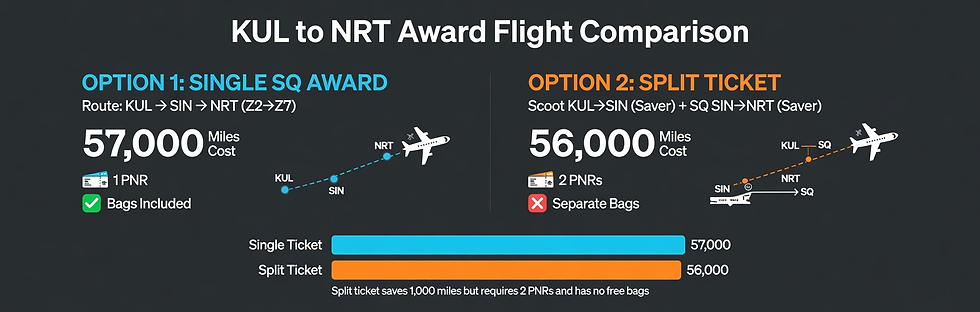
The split saves 1,000 miles but requires two separate bookings, two separate cancellation regimes (Scoot awards are essentially non-refundable), no through-checked baggage, and a self-managed connection at Changi.
For Business Class passengers travelling with luggage, the 1,000-mile saving is almost certainly not worth the operational risk. For a solo Economy traveller with carry-on only, the calculus tilts slightly toward the split.
The Routes That Matter for Malaysians
Not every Spontaneous Escapes route deserves your attention. Here is how I think about categorising them from a Malaysian perspective.

Tier 1: North Asia in Business Class
Routes: SIN–NRT, SIN–HND, SIN–ICN, SIN–KIX, SIN–TPE (when available in J)
These appear on the Spontaneous Escapes list in Business Class every few months, not every edition, but regularly enough that patient collectors will catch them.
When they appear, the KUL-origin Promo rate of approximately 39,900 miles for Tokyo or Seoul Business Class is exceptional value. Even at the year-round Saver rate of 57,000 miles, these routes are where the SQ-vs-MH comparison becomes genuinely interesting. More on that below.
Tier 2: South Asia and Oceania
Routes: SIN–DEL, SIN–BLR, SIN–CMB, SIN–MLE, SIN–CNS, SIN–DRW
South Asian destinations appear in Business Class on almost every monthly edition. Cairns and Darwin rotate in regularly. These are solid redemptions, though verify the specific zone-pair pricing from Zone 2 before booking, some coverage has noted that Zone 6 destinations (India, Sri Lanka, Maldives) may have limited or excluded Promo availability on married KUL-origin bookings in certain months.
Tier 3: Southeast Asia...Skip It
Routes: SIN–BKK, SIN–DPS, SIN–CGK, SIN–HAN, SIN–SGN, SIN–MNL
Malaysia Airlines serves most of these destinations directly from KUL at competitive Enrich pricing. The transit through SIN adds meaningful time on a short-haul route where the flight is only 2–4 hours to begin with.
The zone-pair premium from KUL further weakens the value. Unless you are specifically chaining a Southeast Asian segment with a longer SQ itinerary, these routes are not worth your KrisFlyer miles from KUL.
The Strategic Question: SQ via SIN or MH Direct?
Honestly speaking, I hesitated writing this section, given that I don't know more than 10 Refined Points readers still going for Enrich miles. Nevertheless, I recognize that there are some unique routes to consider when flying MH, especially those whereby the A330neo has been deployed.
For any destination that both MH and SQ serve, a Malaysian miles collector faces a choice: fly MH direct on Enrich miles, or route through SIN on SQ with KrisFlyer miles. The answer depends on three variables: miles cost, product, and time.
The Miles Comparison
Enrich uses dynamic pricing on Malaysia Airlines metal. The redemption cost for KUL–NRT in Business Class can range from approximately 55,000 to 75,000 Enrich points one-way depending on demand, date, and fare class availability. You never quite know what you will pay until you search.
KrisFlyer, by contrast, uses a published zone-based chart. The numbers are predictable.

Enrich ranges are approximate, based on observed search data. KF Promo rate only available when the route appears on that month's Spontaneous Escapes list in J, historically every few months for North Asia, not every edition. SQ total time includes a typical 1.5–3 hour Changi connection.
The numbers tell a clear story.
At the Promo rate, when available, the SQ routing is cheaper than Enrich at virtually any point in its dynamic range. ~39,900 miles for KUL–SIN–NRT in SQ Business Class undercuts even the floor of Enrich's observed pricing. This is the scenario where Spontaneous Escapes delivers genuine, unambiguous value for Malaysians.
At the Saver rate, the KrisFlyer routing (57,000 miles) sits at the lower end of Enrich's dynamic range. If Enrich is pricing your dates at 55,000–60,000 points, the two programmes are essentially equivalent on cost, and the deciding factor is product and time. If Enrich is pricing above 65,000, KrisFlyer Saver is clearly cheaper.
Taipei is the exception. At Saver rates (~47,000 via SIN), KrisFlyer is competitive with Enrich's mid-range, but the shorter MH direct flight (~4.5 hours) weakens the case for transiting SIN. Taipei is where MH direct is likely the more sensible call unless you specifically want the SQ experience.
The Product Gap
Let me be absolutely clear. The gap between Singapore Airlines Business Class and Malaysia Airlines Business Class, even on the A330neo, is not marginal. It is categorical.
It's genuinely hilarious to read opinions that the new MH A330neo is a step above ANY of Singapore Airlines Business Class seats in any given way.
Singapore Airlines operates its 2017-generation or newer Business Class on most North Asia routes: a 1-2-1 fully-flat configuration with direct aisle access, 78-inch bed length, 18-inch IFE, and a soft product, the food, the Book the Cook meal pre-selection, the wine list, the service consistency, that is routinely rated among the top three in the world. On certain rotations, you may get the A380 upper deck with the 2024-generation product.
Malaysia Airlines operates a mix on North Asia routes. Granted, the A330neo features a respectable Collins Aerospace Super Diamond suite in 1-2-1 with privacy doors, a genuine improvement. But the A330neo is not guaranteed on every North Asia flight. Tokyo Narita is partially transitioned; Seoul and Taipei still frequently see the A330-300 with a seat that does not belong in a conversation about modern Business Class.
Even comparing best-case MH A330neo against SQ B777-300ER, the hard product is broadly competitive, but the soft product is not. SQ's meal quality, wine selection, and cabin crew service are in a different league. The A330neo narrows the hardware gap. The experience gap remains wide.
The Time Trade-Off
Routing through SIN adds approximately 2.5 to 4 hours depending on connection time at Changi.
Evening departures: The time penalty is nearly irrelevant. You will sleep through the SIN–NRT sector regardless. The difference is the quality of what you sleep on, and SQ is the clear winner. Changi's SilverKris Lounge during the transit is an amenity, not an inconvenience.
Daytime departures: The penalty is more meaningful. Three extra hours on a daytime itinerary is a real cost, especially for business travellers. MH direct is defensible here.

What About Scoot?
Short answer: almost certainly not worth your attention for Refined Points readers.
The Scoot Spontaneous Escapes discount is 15% off Saver rates. For KUL–SIN, that reduces the Saver cost from 1,500 miles to approximately 1,275 miles one-way. Trivially cheap in absolute terms. The problem is the value per mile.
Scoot KUL–SIN is a 1-hour flight on a low-cost carrier. No checked bag, no meal, no entertainment. The cash fare typically runs RM120–RM350.
Redeeming 1,275 miles for a RM150 cash fare delivers roughly 11.8 sen per mile. The same mile, redeemed for SQ Business Class to Tokyo at Promo rates, delivers 25–40 sen per mile. Every mile you spend on Scoot is a mile that could have been worth 2–3x more elsewhere.
The one scenario where Scoot makes sense: you want to spend time in Singapore independently of your SQ flight, a separate layover day before an onward departure. In that case, 1,275–1,500 miles is a reasonable convenience fee for a standalone positioning flight.
But remember that Scoot and SQ cannot be combined on a single award booking, they are always separate bookings with separate rules.
For connecting itineraries, the single-PNR SQ award through KUL–SIN–[destination] is the right tool. The 1,000-mile saving from split-ticketing with Scoot is not worth the baggage and connection risk.
The KrisFlyer Strategy
For readers who already have KrisFlyer miles, the action is simple: check the list on the 15th, book if compelling. For those building a KrisFlyer balance from Malaysian bank points, two things matter.
Transfer timing: Most bank-to-KrisFlyer transfers take 24 to 48 hours. With booking deadlines at month-end, initiate transfers no later than the 27th. Better yet, maintain a standing KrisFlyer balance of 57,000+ miles (enough for one-way North Asia Business Saver from KUL) and top up regularly.
Taxes: Award tickets are taxed in SGD. Expect a 1–2.5% FCY fee. Use a card that earns on online travel or waives FCY fees.
Full MPR breakdowns are in my 2026 Airline Miles Strategy and KrisFlyer Ultimate Guide. I won't be going into detail on which credit card you should be using for KrisFlyer miles as I already have tons of articles on these on my blog.
Of course, it goes without saying that you should keep in mind the below:
Set a calendar reminder for the 15th of every month. The list goes live mid-morning Singapore time. Act within hours, or else Business Promo seats disappear.
Final Thoughts
KrisFlyer Spontaneous Escapes has been running for nearly a decade, but most Malaysians have ignored it, reasonably, given that the mechanics of using it from KUL were not well understood and the pre-November 2025 pricing parity made it a less distinctive proposition.
Both of those things have changed.
The November 2025 devaluation introduced a 2,500-mile Malaysian positioning premium for long-haul Business awards. This is a small but real cost that makes it more important, not less, to understand when and how to use KrisFlyer optimally from KUL. Spontaneous Escapes, with its 30% Promo discount, is one of the few tools that can erase that premium and then some.


MH does NOT have angled-flat seats on their A330s anymore, or any of their fleet types - not for nearly a decade. It’s quite shocking that a supposed expert of the Malaysian air travel scene can get such an important point wrong.