

First Look: Hong Leong Bank Opus Visa Infinite Privilege
Updated: Sep 5

“How beautiful it is and how easily it can be broken.” — Tennessee Williams, The Glass Menagerie
There was a time when Hong Leong Bank was little more than an afterthought in Malaysia’s premium credit card market.
The bank had affluent customers, a credible wealth franchise and an established Visa Infinite lineup, but its cards rarely featured in any serious conversation about airline miles. Maybank had scale. CIMB had conversion partners. UOB had earn rates. Hong Leong Bank, for the most part, played second fiddle.
Those days are over.
The turning point came in 2025, when Hong Leong Bank completely overhauled the rewards proposition across its Visa Infinite lineup. The HLB Visa Infinite and invitation-only HLB Visa Infinite P began earning an extraordinary 1 Enrich Point per RM1 on both local and overseas dining, instantly turning two previously unremarkable products into Malaysia’s strongest uncapped dining cards for Enrich Miles.
That refresh was not merely generous. It was strategically revealing. Hong Leong Bank had identified a spending category it wanted to own, accepted the rewards cost required to own it and created something meaningfully different from the market.

The HLB Opus Visa Infinite Privilege was supposed to be the culmination of that transformation. Visually, it absolutely is. The name is hardly subtle. An opus is an artist’s major work, and Hong Leong Bank clearly intends this card to be viewed in precisely those terms. It is Malaysia’s first Visa Infinite Privilege credit card and, according to the bank, the first card in the region made exclusively from ceramic.

The result is spectacular. Smooth, minimalist and entirely unlike the growing pile of interchangeable black metal cards on the market, the HLB Opus may be the most beautiful consumer credit card ever issued in Malaysia.
Unfortunately, beauty is not the same thing as substance.
Now that Hong Leong Bank has published the full product page and card terms, the Opus proposition looks considerably thinner than its positioning suggests. Yes, it earns an industry-leading 2.5 MPR on eligible transactions in five selected countries. Yes, it provides unlimited access to a sizeable Plaza Premium network, including Plaza Premium First. It also carries the broader Visa Infinite Privilege portfolio of travel, hotel, wellness and lifestyle benefits.
However, the card charges the same RM3,000 annual fee as the UOB Visa Infinite Metal Card while offering no Priority Pass or DragonPass membership, no disclosed airport limousine benefit and no flexibility beyond Enrich Miles.
The HLB Opus is a more beautiful object than the UOB Visa Infinite Metal Card. The problem is that UOB has built the better credit card.
Let’s dive in.
Qualification Criteria and Annual Fee
The HLB Opus Visa Infinite Privilege is issued strictly by invitation and positioned for ultra-high-net-worth clients within the HLB Private Bank ecosystem.
Hong Leong Bank does not publish a standalone income or Assets Under Management requirement on the card page. In practice, HLB Private Bank generally begins at RM3 million in AUM, although satisfying that threshold should not be interpreted as an automatic entitlement to the card.
The published fees are considerably less ambiguous:
Principal annual fee: RM3,000
Supplementary annual fee: RM2,000
Card replacement fee: RM1,900
Hong Leong Bank explicitly states that the annual fee and replacement fee are non-waivable. This is particularly striking when the existing HLB Visa Infinite and HLB Visa Infinite P are both free for life.
For a principal cardholder with one supplementary card, the annual cost rises to RM5,000 before the RM25 service tax imposed on each card. Lose or damage the ceramic card and replacing it costs another RM1,900.
Apparently, art restoration does not come cheap. The RM3,000 principal annual fee does include 60,000 Enrich Points, which are credited within 60 days after the fee is paid. However, this should not be mistaken for a complimentary welcome gift. It is an annual points package attached to a compulsory fee.
The arithmetic is simple: RM3,000 divided by 60,000 Enrich Points = 5 sen per Enrich Point
You would therefore need to value every Enrich Point at 5 sen merely to recover the annual fee through the points package alone. I certainly do not.
The closest comparison is the UOB Visa Infinite Metal Card, which also charges a non-waivable RM3,000 annual fee and awards 300,000 UNIRinggit upon payment. At the Metal card’s preferential conversion rate, that is also equivalent to 60,000 airline miles.
The difference is optionality. UOB lets cardholders convert those points into Enrich Miles, KrisFlyer miles or Asia Miles. Hong Leong Bank gives you Enrich Points and ends the conversation.
UOB also charges RM800 for a supplementary Metal card, compared with RM2,000 for the HLB Opus. The comparison is not completely one-sided because Opus supplementary cardholders receive lounge privileges while UOB supplementary cardholders no longer do, but RM2,000 remains an extraordinary amount to charge for an additional relationship card.
An annual fee is not automatically objectionable when the recurring benefits justify it. The issue is that HLB is already asking the client to maintain a private-banking relationship, allowing the bank to earn from deposits, investments, financing and a much broader share of wallet. Charging another RM3,000 can still work, but the card then needs to deliver a package that is obviously worth RM3,000.
I do not think the HLB Opus clears that threshold. For many prospective cardholders, the annual fee will be the deal breaker before the ceramic ever leaves its presentation box.
Airline Miles Earning Rates
There is an increasingly lazy claim that wealthy customers do not care about airline miles. The market itself provides the best rebuttal.
Banks are relentlessly focused on margins. They do not fund expensive rewards liabilities for sport, nor do they compete on earn rates out of intellectual curiosity. If private-banking clients genuinely did not care about miles, products such as the HLB Opus Visa Infinite Privilege, UOB Visa Infinite Metal, Standard Chartered Beyond Visa Infinite Priority Private and CIMB Private Wealth World Elite would not be designed around increasingly aggressive travel rewards.
The HLB Opus does not merely challenge the hypothesis. Its 2.5 MPR headline thoroughly demolishes it.
The card’s published earn rates are as follows:

All earn rates are uncapped. The 1 MPR dining rate remains excellent. It matches the existing HLB Visa Infinite lineup and the UOB Visa Infinite Metal Card, while requiring no published monthly spending threshold. One small technical wrinkle is that HLB’s dining definition includes MCC 5811, 5812 and 5814, but omits MCC 5813 for drinking places. A restaurant should qualify; a bar may not.
Travel and retail shopping earn 1 Enrich Point per RM3, equivalent to approximately 0.33 MPR, while everything else falls to 0.2 MPR. These rates are respectable only when compared with Hong Leong Bank’s own lower base rates. In the wider premium-card market, neither is compelling.
Then we arrive at the headline attraction. Eligible transactions in Singapore, the United Kingdom, Japan, Thailand and South Korea earn 2.5 Enrich Points per RM1, irrespective of spending category and without a monthly cap.
These are sensible corridors. Singapore is Malaysia’s most obvious regional business market, while Japan, Thailand and South Korea are major leisure destinations. The United Kingdom captures education, property, family and travel spending for a meaningful segment of Malaysia’s ultra-high-net-worth population.

Within those five markets, 2.5 MPR is exceptional. Dining, hotels, airlines, department stores, luxury shopping, transport and most other eligible transactions can all earn at the same accelerated rate.
However, there is a very important clause in the terms that completely changes how the benefit must be understood.
The 2.5 MPR Rate Is Based on Country Code, Not Transaction Currency
Hong Leong Bank explicitly states that the five-country accelerator is based solely on the transaction’s country code, regardless of the currency in which the transaction is charged.
For avoidance of doubt, the special rate for Overseas spend (selected 5 countries) is based solely on the country code regardless of the transaction currency. The applicable country code can be viewed on the monthly Card statement, identified as the last three (3) letters of the transaction description.
The relevant country code appears as the final three letters of the transaction description on the monthly card statement.
In other words, this is not an SGD, GBP, JPY, THB or KRW accelerator. It is an acquiring-location accelerator.
Suppose an online merchant processes a transaction through a Singapore acquiring entity but charges you in Hong Kong Dollars. If the transaction ultimately appears with the SGP country code, it should earn 2.5 MPR despite being denominated in HKD.
The reverse is equally important. If a merchant charges you in Singapore Dollars but processes the transaction through a Hong Kong acquiring entity, the statement may show HKG. In that case, the transaction would not qualify for 2.5 MPR merely because SGD was selected at checkout.
The same principle applies everywhere else. A hotel booking displayed in GBP is not necessarily a United Kingdom transaction. An airline ticket charged in JPY is not necessarily coded to Japan. Conversely, a transaction charged in MYR could theoretically qualify if it carries one of the five eligible country codes, although accepting Dynamic Currency Conversion would still be a terrible idea because the merchant’s exchange rate could cost far more than the additional miles are worth.
This destroys the easy online optimisation strategy I initially expected. Changing the payment currency on an airline, hotel or online travel agency website does not guarantee 2.5 MPR. The merchant’s acquiring setup determines the country code, and that information is often invisible until the transaction appears on your statement.
The practical rule is therefore straightforward: Ignore the currency symbol. Check the final three-letter country code.
For physical spending during a trip, the outcome should generally be predictable. For online transactions processed through regional or global acquiring entities, there is far more uncertainty.
How Does 2.5 MPR Compare?
Within the five eligible country codes, the HLB Opus Visa Infinite Privilege offers the strongest uncapped headline earn rate in Malaysia.
The UOB Visa Infinite Metal earns 2 MPR on eligible foreign-currency spend worldwide. The Standard Chartered Beyond Visa Infinite Priority Private earns up to 2.14 MPR on overseas dining and shopping, with other eligible overseas spend earning 1.42 MPR. CIMB’s private-wealth and travel cards offer lower headline rates, but compensate with a much wider collection of airline conversion partners.

HLB therefore wins decisively when a transaction is coded to Singapore, the United Kingdom, Japan, Thailand or South Korea. Outside those five markets, the hierarchy reverses just as decisively.
Spend in Hong Kong, Australia, the United States, China, Indonesia or most of Europe and the HLB Opus falls back to 1 MPR for dining, approximately 0.33 MPR for travel and retail shopping, or 0.2 MPR for everything else. The UOB Visa Infinite Metal continues earning 2 MPR on eligible foreign-currency spend across those markets.
The difference is enormous. Spend RM100,000 on an eligible transaction coded to Japan and the HLB Opus earns 250,000 Enrich Points, compared with 200,000 airline miles on the UOB Visa Infinite Metal.
Spend the same RM100,000 on a hotel transaction coded to France and the Opus earns approximately 33,333 Enrich Points. UOB still earns 200,000 airline miles, subject to its own exclusions.
That is not a minor geographical limitation. It is a cliff. This is why the UOB Visa Infinite Metal remains the HLB Opus card’s closest and most dangerous competitor. HLB offers a higher peak. UOB offers substantially greater consistency, broader geographical coverage and a choice among three airline programmes.

The Standard Chartered Beyond Visa Infinite Priority Private remains relevant for broad overseas dining and shopping spend, while CIMB retains the strongest conversion ecosystem. The Maybank Visa Infinite Diamanté and AmBank SIGNATURE Priority Banking The Metal Visa Infinite remain so far removed from the serious miles conversation that neither requires further discussion here.
Airport Lounge Access
The HLB Opus Visa Infinite Privilege provides unlimited access to a dedicated list of lounges and airport dining outlets managed or affiliated with Plaza Premium Group.

The benefit applies to both principal and supplementary cardholders. Hong Leong Bank’s terms also extend access to accompanying guests without publishing a numerical guest cap, making the wording unusually generous on paper.
Entry is refreshingly simple. Cardholders present the physical HLB Opus card together with a boarding pass.
Most importantly for Malaysian travellers, Plaza Premium First at KLIA Terminal 1 is included. The wider Plaza Premium First list also covers selected locations in Hong Kong, Jakarta, Rome, Macau and Dallas, with Bangkok and Riyadh listed as opening soon.
I've covered the Plaza Premium First at KLIA T1 extensively, but have also reviewed the Plaza Premium First at Jakarta Soekarno Hatta Terminal 3, which at the time of opening was exclusively available for CIMB credit cards. It goes without saying that the HLB Opus VI Privilege grants you access to both, which is sweet.

Plaza Premium First access is a meaningful qualitative advantage. I have said this repeatedly: Plaza Premium First is considerably more premium than UOB’s roped-off private section inside the standard Plaza Premium Lounge at KLIA. The food, service and overall environment are simply better.
This is therefore a decent lounge proposition. It is unlimited, it includes guests, it accommodates supplementary cardholders and it provides access to the best independent lounge at KLIA Terminal 1.
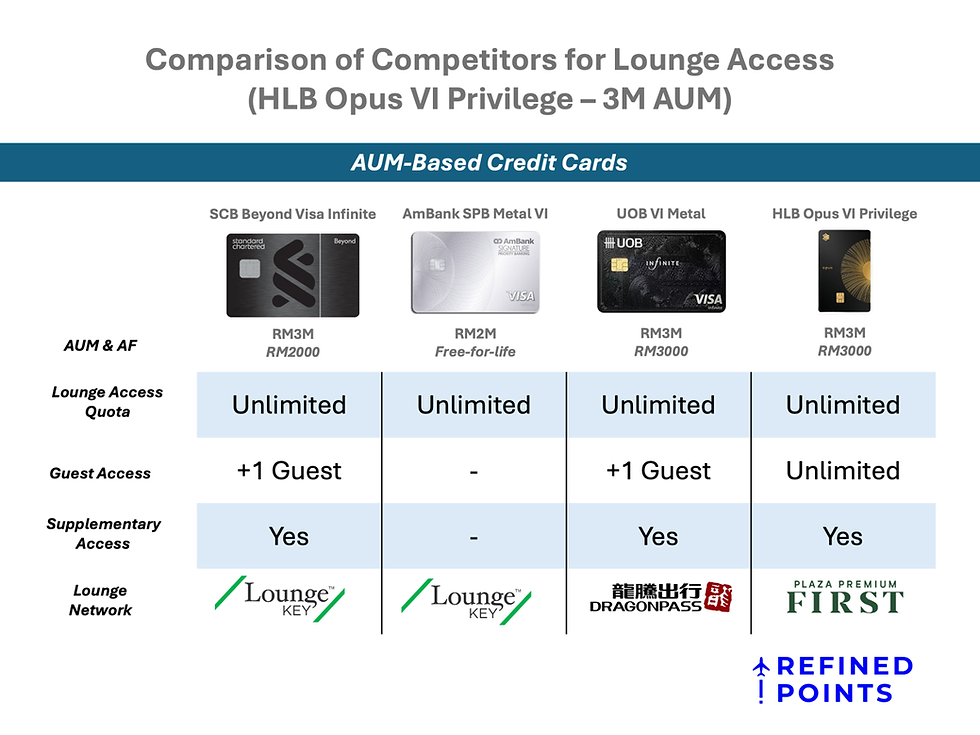
It is also surprisingly underwhelming for a RM3,000 Visa Infinite Privilege card. The HLB Opus does not include Priority Pass. That omission is particularly strange when the lower-tier HLB Visa Infinite P provides four Priority Pass visits per year. There is something faintly absurd about moving to Hong Leong Bank’s new flagship tier, paying RM3,000 annually and losing access to the world’s most recognisable independent lounge programme.
The participating Plaza Premium list is broad and includes affiliated operators, but it remains a fixed, curated network. It does not provide the same universal familiarity or sheer coverage associated with Priority Pass, nor does it match the unlimited DragonPass footprint offered by the UOB Visa Infinite Metal.
At this level, cardholders should not have to choose between quality and breadth. The obvious premium solution was to provide unlimited Plaza Premium Group access, including Plaza Premium First, alongside a reasonable Priority Pass allocation for airports outside the network.
Hong Leong Bank chose only the former. Against UOB, the comparison is nuanced. The HLB Opus is stronger for Plaza Premium First access and supplementary cardholders. UOB’s Metal card is stronger for global breadth through DragonPass, although its lounge benefit is now limited to the principal cardholder and one guest.
HLB has built the more luxurious benefit at selected airports. UOB has built the more dependable benefit across an entire travel calendar.
No Airport Limousine Benefit
The HLB Opus Visa Infinite Privilege does not appear to include a complimentary airport limousine or airport transfer benefit. This is a major omission because airport transfers are among the few premium-card benefits that solve a real, recurring problem for travellers.
The UOB Visa Infinite Metal Card offers unlimited complimentary rides from eligible Klang Valley locations to KLIA Terminal 1 and KLIA Terminal 2. The Standard Chartered Beyond Visa Infinite Priority Private provides six annual Grab airport transfers worth up to RM100 each. HLB provides neither.

When two competing cards both charge RM3,000 a year, and one repeatedly drives you to the airport while the other asks you to admire its ceramic construction in traffic, the comparison becomes rather uncomfortable.
Travel, Dining and Lifestyle Benefits
The remaining HLB Opus benefits are respectable, although most are better understood as additions to the proposition rather than reasons to pay RM3,000 for it.
Cardholders also receive four golf games annually and access to the wider Visa Infinite Privilege benefit suite. Hong Leong Bank highlights Essentialist hotel benefits, ALL Accor+ Explorer and with Banyan Voyager status matches, Harrods Gold status, complimentary wellness treatments at Chenot in Switzerland and Lanserhof in Austria and Germany, together with Visa Concierge access.

There is also an invitation to a custom-curated series of culinary experiences hosted by in-demand chefs across the region.

That sounds lovely. It is not yet a benefit I can value. Hong Leong Bank has not published a standing restaurant list, redemption frequency, monetary entitlement or guaranteed dining mechanic. An invitation-only event can be memorable, but it is fundamentally different from a recurring dining credit or a clearly defined one-for-one programme.
The same distinction applies to the hotel proposition. Status matches and preferred hotel benefits can improve a stay, but the current HLB Opus card terms do not disclose a recurring bank-funded complimentary hotel night.
Visa Infinite Privilege benefits still add useful depth, particularly for cardholders who can naturally use the participating hotel and wellness brands. However, these are largely network-level privileges. They are not unique to Hong Leong Bank, they may require separate enrolment and they can change independently of the card’s core rewards proposition.
Before relying on any hotel status benefit, I would still compare the public price and cancellation terms on Trip.com here. A shiny status badge is not valuable if the same room can be booked materially cheaper elsewhere.
Likewise, readers planning an Accor stay can compare eligible Accor hotel rates here before deciding whether the ALL Accor+ Explorer benefit genuinely changes the economics of the booking.
Hong Leong Bank’s own page promises “so much more to come”. Perhaps more will arrive. Until it does, it cannot be included in the valuation.
The Great Flaw: 2.5 MPR Is Still 2.5 Enrich MPR
And now we arrive at the crack in the ceramic. The HLB Opus Visa Infinite Privilege earns an extraordinary 2.5 MPR within five country codes, but every one of those miles is an Enrich Point.
Miles per Ringgit measures the speed of accumulation. It does not measure the value of the eventual redemption.
One Enrich Point cannot automatically be treated as equivalent to one KrisFlyer mile, one Asia Mile or one Avios. Each programme has different award prices, availability, routing rules, change policies, surcharges and airline partners. A card can therefore earn more miles per Ringgit while still delivering less travel value when those miles are finally redeemed.
This matters enormously with Enrich. Saver awards can offer reasonable value when they are available, but other Malaysia Airlines redemptions can require substantially more points. Oneworld partner redemptions are possible, although the process remains less seamless than booking partners online through programmes such as British Airways Club or Cathay.
Then there is the underlying airline product. Earning 2.5 MPR is considerably less exciting when the most obvious redemption is another poor regional Malaysia Airlines Business Class recliner. Accumulating points faster does not transform a Boeing 737 seat into Qsuite

.
The annual bonus makes the restriction even harder to ignore. Both HLB Opus and UOB Visa Infinite Metal effectively award 60,000 airline miles after the RM3,000 annual fee is paid. HLB forces those 60,000 points into Enrich. UOB allows the cardholder to choose among Enrich, KrisFlyer and Asia Miles.
That flexibility has real option value. The best redemption programme today may not be the best redemption programme when the cardholder is finally ready to book.
Hong Leong Bank does deserve credit for simplicity. Enrich Points are automatically credited to the cardholder’s Enrich account, removing transfer fees, conversion blocks and the risk of orphan bank points.
Unfortunately, simplicity and confinement are separated by a very thin line.
For a loyal Malaysia Airlines customer who regularly redeems Enrich Saver awards, values direct crediting and spends heavily in the five eligible markets, the Opus can still be formidable. For everyone else, the difference between “2.5 MPR” and “2.5 Enrich MPR” is not semantic. It is the most important qualification attached to the card.
I will publish a separate article comparing the effective redemption value of the HLB Opus against cards earning KrisFlyer miles, Asia Miles and Avios. That analysis deserves actual routes, award prices and cabin comparisons rather than another superficial MPR table.
For now, the conclusion is simple: Earning more miles is not the same as earning more value
Final Thoughts
The Hong Leong Bank Opus Visa Infinite Privilege is not a bad credit card. It is simply an underwhelming flagship.
The physical card is extraordinary. The 2.5 MPR accelerator is genuinely industry-leading within the five eligible country codes. Unlimited access to the Plaza Premium Group network is useful, and the inclusion of Plaza Premium First, supplementary cardholders and accompanying guests gives the lounge proposition real substance. The RM2 million travel insurance coverage is also strong.
However, expectations were not set by an ordinary premium card.
This is Malaysia’s first Visa Infinite Privilege card. It is issued by invitation to ultra-high-net-worth clients. It sits within a private-banking relationship. It charges a non-waivable RM3,000 principal annual fee, another RM2,000 for a supplementary card and RM1,900 if the ceramic needs replacing.
At that price, “good” is not good enough. The absence of Priority Pass or DragonPass is surprising. The absence of any disclosed airport limousine benefit is worse. The annual 60,000-point package is confined to Enrich, while the five-country accelerator becomes dramatically less attractive outside its selected acquiring locations.
Most importantly, the UOB Visa Infinite Metal charges the same principal annual fee and already solves these weaknesses. It offers 2 MPR across eligible foreign-currency spend worldwide, three airline conversion partners, unlimited DragonPass access for the principal cardholder and a guest, and unlimited limousine rides to KLIA.
Hong Leong Bank has undoubtedly stopped playing second fiddle in design and headline earn rates. The HLB Opus proves that the bank is willing to take risks, invest in product theatre and create something the Malaysian market has never physically seen before.
What it has not done is dethrone UOB.
For an existing HLB Private Bank client who is deeply committed to Enrich, spends heavily in Singapore, the United Kingdom, Japan, Thailand or South Korea, and values Plaza Premium First access, the HLB Opus can still make sense.
For everyone else, I struggle to justify the annual fee. I certainly would not relocate RM3 million in assets to obtain it, and I would not choose it over the UOB Visa Infinite Metal on the strength of the published proposition today.
Hong Leong Bank may have created the most beautiful credit card in Malaysia. UOB still has the better credit card. The ceramic may be hard-fired. The value proposition is surprisingly fragile.


IMO HLB really missed the chance to make Visa Infinite Privilege a proper rival to Mastercard World Elite here. World Elite actually built solid brand equity in Malaysia because the perks back it up, proper global lounge access, hotel elite hooks, and actual travel privileges. With the Opus, take away the ceramic novelty and what’s actually 'Privilege' about it compared to a standard VI? No meet-and-assist, zero hotel tie-ups, and you’re still queuing at PPL like everyone else.
Honestly, carrying a ceramic card with a RM1,900 replacement fee sounds like pure anxiety. It looks gorgeous in photos, but ceramic is ceramic, one bad drop on tile floor or touch wood one parking machine makan the card, GG, RM1,900 gone just like that.
Handing it to a waiter also will get heart attack 😂
Great article again Kingsley 🙏
Good catch on the fx spend acquiring bank detail. For a mandatory RM3,000 annual fee card, having to second-guess payment gateway routing on every overseas swipe is massive friction especially when other cards can do uncapped globally with zero restrictions
I like the article, but I think the market is being a bit generous because it’s ceramic and “first Visa Infinite Privilege in Malaysia.” On paper HLB opus is Infinite P with a better body, a better lounge line, a 60k Enrich bonus, and a 2.5 MPR corridor in five countries. That corridor is genuinely good. 2.5 Enrich Points per ringgit in Singapore, Japan, Thailand, Korea and the UK beats most of the open-market Malaysian cards and sits above the UOB VIM flat 2.0 overseas MPR, at least on those five corridors. If you actually live part of the year in those markets, this becomes interesting. Everywhere else it is not interesting. The 1 Elite Point per RM10,000 overseas spend…