

Explained | Complimentary Business Class Upgrade on Standard Chartered Beyond Visa Infinite Malaysia

There is an old medieval maxim that still applies today: a gilded helmet does not win the battle. It merely distracts from the cracks beneath it.
That line neatly captures the reality of Standard Chartered Malaysia’s so-called “complimentary Business Class upgrade” benefit on the Standard Chartered Beyond Visa Infinite Priority Private.
On the surface, it reads like a premium headline perk. In practice, it is a mechanically constrained, statistically unfavourable, and strategically misaligned benefit that feels far more like an AUM-conversion lever than a genuine reward for the bank’s most affluent customers.
This matters because Priority Private clients are not aspirational affluent. They are the affluent. And at that level, value is judged not by how impressive something sounds, but by how reliably it delivers.
Understanding What This “Upgrade” Really Is
Let’s start with the facts as communicated.
The Business Class upgrade benefit on the Beyond Visa Infinite Priority Private is usable once per calendar year, restricted to destinations within Asia, and tied exclusively to Malaysia Airlines.
To trigger it, the principal cardholder must book via 24/7 Visa Concierge at least 14 days prior to departure, and must purchase one Business Class ticket (any fare type) plus one Economy Class ticket in the highest fare bucket. The upgrade is then applied to that Economy ticket into Business Class in the lowest fare bucket, subject to seat availability, airline fare rules, and confirmation at the time of booking, and it explicitly excludes taxes and other fees.
Framed plainly, you are being encouraged to lock in top-tier pricing for an outcome that is conditional, tightly scoped, and only usable once annually.
The itinerary must start and end in Malaysia (a return flight), you and your travel companion must be on the same flight itinerary, and only one upgrade may be redeemed per itinerary. Most importantly, the bank is blunt about it: the programme does not guarantee Business Class availability.
Viewed through Standard Chartered’s broader strategy, the intent becomes clearer. This benefit is not primarily designed to delight existing Priority Private customers. It is designed to nudge Priority Banking customers to move RM3 million in AUM up one tier, using a headline perk as psychological motivation.
The AUM Strategy is Obvious — And Flawed
Standard Chartered has always operated a relationship-led model. The credit card is not the product; it is the conduit. The real objective is AUM retention, investment flows, FX activity, and wealth product penetration. The card merely makes the relationship tangible in daily life.
The Beyond Visa Infinite structure amplifies this approach. By introducing a higher tier (Priority Private), the bank needs a visible differentiator to justify the leap. A higher annual fee alone is not enough. Nor is incremental MPR. So the bank introduces a trophy benefit — a Business Class upgrade — to create perceived step-change value.
The problem is that this trophy does not hold up to scrutiny.
At RM3 million in assets, customers are not value-naïve. They do not need a bank to teach them how to extract “hidden upside”. They already understand airline pricing, fare classes, upgrade mechanics, and opportunity cost. Which is precisely why this benefit unravels the moment you examine it rationally.
Upgrade Mechanics Are Never As Simple As They Sound
Even before we discuss Malaysia Airlines’ cabin product, the structure of the upgrade itself is problematic.
Even before we talk about Malaysia Airlines’ cabin product, the structure of the upgrade is already doing too much. Everything must be purchased and redeemed through Visa Concierge, which means you are effectively operating through a quotation-and-confirmation process rather than booking directly with the airline the way seasoned travellers normally would.
And while the paid Business Class ticket can be on any fare type, the Economy ticket must be the highest fare bucket, which is exactly the part that makes the “upgrade” feel less like a perk and more like a forced purchase.
In addition, “complimentary” comes with the usual asterisks, except the asterisks are doing most of the work here. Taxes, surcharges, merchant fees, and other applicable charges are not covered and will be billed to your card, and the upgraded ticket is non-transferable and non-endorsable.
If you need to change or cancel, you’re bound by Malaysia Airlines’ fare rules, you must request modifications at least 72 hours prior to departure, and there is an additional service charge of SGD50 per call when Visa Concierge contacts their appointed travel desk to process a booking modification.
None of this aligns with how genuinely affluent travellers prefer to book. They value certainty, flexibility, and product quality, not conditional upside.
Now layer Malaysia Airlines on top of this structure, and the value proposition deteriorates further.
The Malaysia Airlines Fleet Reality
This is where facts matter.
As of early 2026, Malaysia Airlines’ Asian network is overwhelmingly narrow-body dominated. Based on fleet deployment data, the airline serves approximately 62 Asian destinations, of which 48 are operated by Boeing 737-800 or 737-8 MAX aircraft. That means over 77% of Malaysia Airlines’ Asian routes are narrow-body.

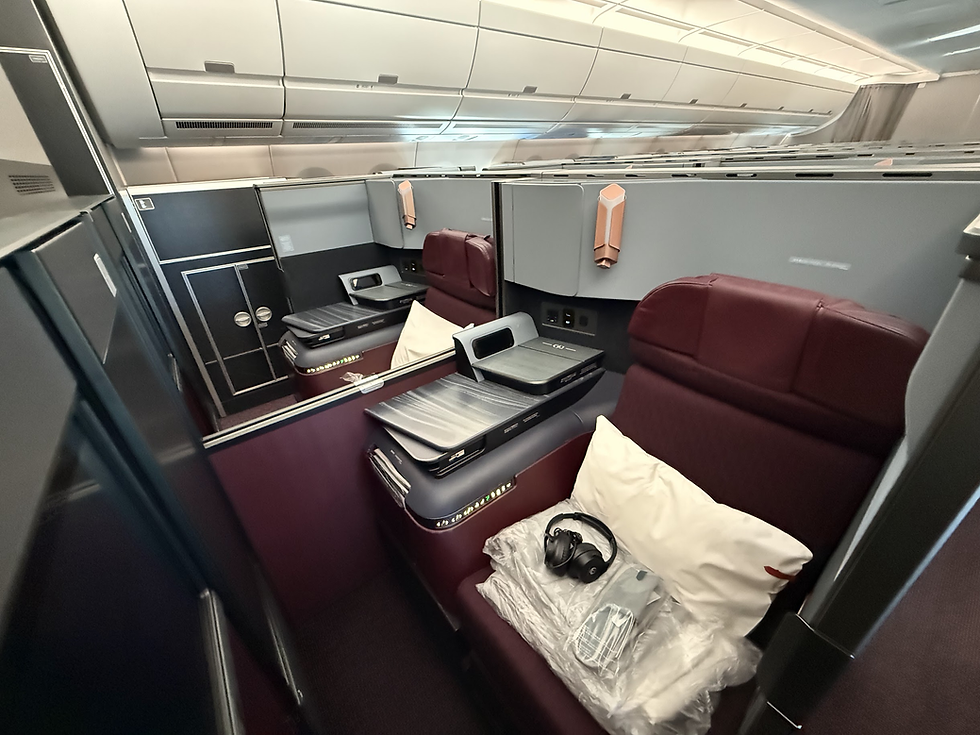
The current fleet consists of roughly 40 Boeing 737-800s and 14 Boeing 737-8 MAX aircraft, which together form the backbone of the airline’s regional operations across ASEAN, South Asia, and parts of East Asia. These aircraft feature recliner-style Business Class seats, not lie-flat products.

Yes, Malaysia Airlines is modernising. Yes, the A330-900neo is entering service. And yes, the new Business Class suites on those aircraft are excellent. But fleet renewal is gradual, not instantaneous. Even in 2026, wide-body deployment remains limited to select high-density routes and seasonal rotations.
The reality is simple: a Business Class upgrade restricted to Asia on Malaysia Airlines statistically means a high probability of ending up on a narrow-body aircraft, especially on popular regional routes.
So when Standard Chartered offers this benefit to Priority Private clients, it is effectively asking them to accept a non-flatbed regional seat as a “premium” reward. That is not editorial opinion. That is fleet mathematics.
Case Study: The Tokyo Problem
Let’s take Japan as a concrete example.
On routes like Kuala Lumpur to Tokyo, Economy Flex fares frequently price above RM6,000, depending on seasonality and demand. That is before you even factor in the additional ticket required to activate the upgrade structure.

At that price point, the proposition becomes absurd.
With RM6,000–RM7,000, you are already within striking distance of 'paid Business Class fares on top-tier airlines', especially during promotional periods or with flexible routing. Cathay Pacific, for example, routinely prices one-way Business Class seats to Japan around that range.

Those seats are confirmed, lie-flat, and come with none of the uncertainty or conditional mechanics attached to an “upgrade”, AND you even get to visit some of the best Business Class lounges in the world in Hong Kong.
So the Priority Private customer is left with a bizarre choice: overpay for an Economy Flex ticket on Malaysia Airlines and hope for an upgrade, or simply buy Business Class outright on a superior product and be done with it.
Affluent travellers do not gamble on hope when certainty is available.
This is where the “complimentary” narrative completely collapses.

The chart makes one thing painfully clear: Economy Flex is not a “cheap ticket” you buy and then pray for an upgrade. On routes like Tokyo, Osaka, and Seoul, Economy Flex already sits around RM2,900 to RM3,850 on average, while Business Class averages RM8,500 to RM11,500.
Yes, the headline “gap” looks massive on paper, but that gap is not a guaranteed saving. It is a theoretical maximum that only materialises if upgrade inventory exists on the exact flight you want.
This is also where the “RM2,000 annual fee is worth it because upgrades cost so much” argument falls apart. You are not being handed a Business Class ticket; you are being required to buy an expensive highest-bucket Economy fare upfront, via concierge, at least 14 days in advance, on a return itinerary that starts and ends in Malaysia, and then hope the upgrade clears.
The T&Cs are explicit that Business Class availability is not guaranteed, so your cost is locked in while your upside remains conditional, and that is not how a true premium benefit should work for Priority Private customers.
In other words, your cost is guaranteed, but your upside is conditional, and that is not how a true premium benefit should work for Priority Private customers.
A Benefit Misaligned With It's Audience
Priority Private customers are globally mobile, time-sensitive, and deeply familiar with premium travel. Their flying patterns skew long-haul, not short-haul. Their expectations revolve around certainty, not conditional perks. They pay to avoid friction, not to navigate it.
Against that backdrop, a once-per-year, Asia-only, Malaysia-Airlines-only upgrade is fundamentally misaligned with how this segment actually travels. It feels like a benefit designed to look good in a pitch deck rather than one designed to integrate seamlessly into an affluent lifestyle.
And that brings us back to the broader issue raised in my First Look article: this card feels like it was built by two different teams.
One team understands affluent behaviour. That team delivered the removal of dining cashback “hunger games” and replaced it with a rational, high-value dining programme. That same team designed the overseas dine-and-shop accelerator, which genuinely aligns with how affluent Malaysians spend when they travel.
The other team designed the Business Class upgrade. That team appears to believe that premium customers are impressed by headline language, rather than substance. That they will accept restrictions quietly. That they will settle for theoretical value instead of guaranteed quality.
That assumption is wrong.
Standard Chartered arguably serves the most sophisticated affluent client base in Malaysia. This is a bank whose top-tier customers are often wealthier, more internationally exposed, and more financially literate than those of any other local institution.
To ask this group to “settle” — whether in cabin quality, in certainty, or in value — is not just a misstep. It is a misunderstanding of the very audience the bank claims to prioritise.
At RM3 million AUM and RM2,000 in annual fees, perks should feel undeniably premium without requiring explanation, justification, or mental gymnastics. This one does not.
Final Thoughts
The complimentary Business Class upgrade on the Standard Chartered Beyond Visa Infinite Priority Private is not a value creator. It is a marketing artefact designed to push tier migration, not to reward loyalty.
It is restrictive, statistically unfavourable, and misaligned with the travel behaviours and expectations of genuinely affluent customers. Worse, it risks signalling that Standard Chartered believes its most valuable clients can be persuaded by optics rather than substance.
That is a dangerous assumption.
If Standard Chartered wants Priority Private to feel truly premium, the answer is not conditional upgrades on regional aircraft. It is clarity, certainty, and benefits that respect the intelligence and lifestyle of the people placing RM3 million with the bank.
This benefit does none of those things.
And once customers run the numbers — which they will — the upgrade stops looking like a privilege and starts looking like a punchline.


Great write up!
Its seriously disspaointing that SC has gone down the path of gimmicks and deception instead of actually making a a simple but valuable premium credit card. Considering the income they'd make of the interest and account fees of 3M RM the value this card offers is pathetic.