

MH4 Passengers and Its Crew Stranded in Manchester

Editor’s note: This is a developing story. Details are accurate as of the morning of 9 September 2026.
Malaysia Airlines flight MH4 from Kuala Lumpur to London Heathrow was diverted to Manchester Airport on 8 September 2026 after a major failure within the United Kingdom’s air traffic control system. The diversion was understandable. Heathrow could not accept the flight, the disruption affected airports across the country and the captain did exactly what safety required.
What reportedly happened after the Airbus A350 landed was far more difficult to defend.
Passengers were left waiting for hours without their checked baggage, a confirmed hotel, onward transport to London or any visible Malaysia Airlines representative to explain what was happening. The most extraordinary part was that the airline’s own pilots and cabin crew were reportedly stranded alongside them, apparently with no accommodation and no reliable line of communication back to Malaysia Airlines.
An entire long-haul flight had landed safely in the wrong city. Malaysia Airlines then appeared to vanish.
What Happened to Malaysia Airlines Flight MH4?
MH4 is Malaysia Airlines’ flagship daily service from Kuala Lumpur to London Heathrow. On 8 September, the flight departed Kuala Lumpur at approximately 10:12am Malaysian time, around 22 minutes behind schedule, using Airbus A350-900 registration 9M-MAC.
The flight was scheduled to arrive at London Heathrow at approximately 4:35pm local time. However, a technical failure affecting the flight-processing system operated by the UK’s National Air Traffic Services, or NATS, severely restricted air traffic across the country.
More than 1,000 flights were ultimately cancelled, while many others were delayed, held or diverted. Heathrow eventually suspended arrivals for the remainder of Tuesday evening as the wider aviation network struggled to recover.
MH4 was diverted north to Manchester Airport, where it landed at approximately 5:04pm local time. One passenger account suggested that around 15 diverted flights had arrived in Manchester amid the wider disruption.
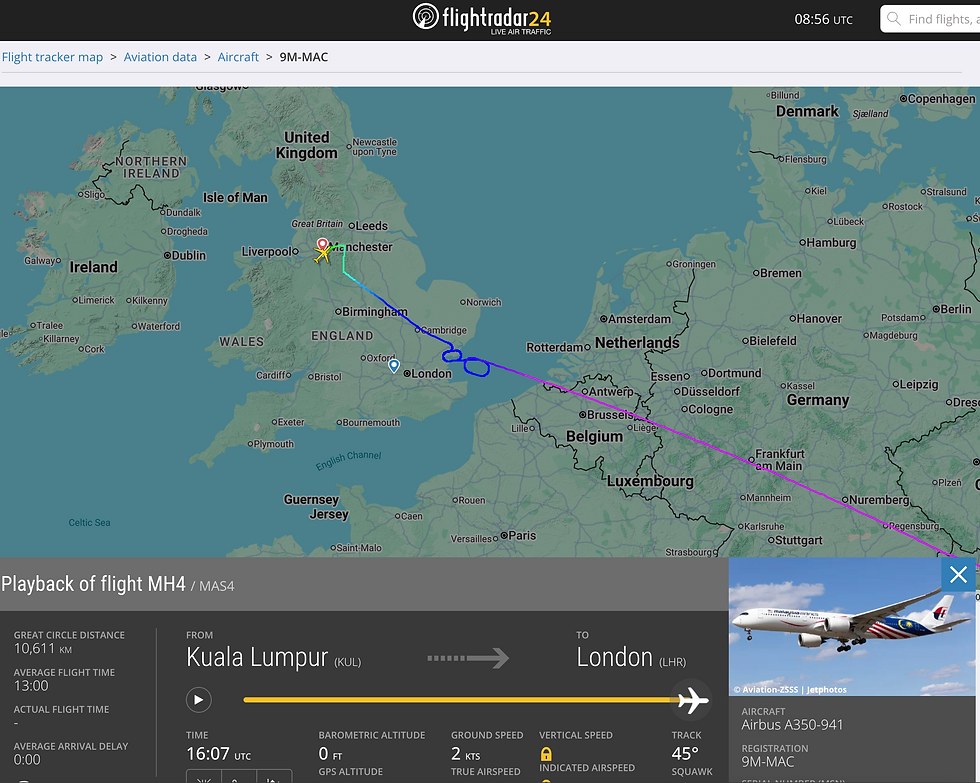
Flight-tracking records also showed a planned Manchester-to-Heathrow continuation under the MH4 flight number that evening. That sector was subsequently cancelled.
To be absolutely clear, none of this made the diversion itself a Malaysia Airlines scandal. A national air traffic control outage is well beyond the airline’s control, and diverting to a suitable airport was the correct operational decision.
The scandal began on the ground.
Hours of Silence at Manchester Airport
After landing, passengers initially remained on the aircraft while arrangements were supposedly being made through Swissport, Malaysia Airlines’ contracted ground handler in Manchester.
The captain reportedly announced that passengers would be accommodated overnight. However, once they eventually entered the terminal, the plan appears to have disintegrated.
According to Malaysian comedian Dr Jason Leong, who was travelling on MH4, passengers then spent between three and four hours waiting in the baggage reclaim area. No carousel had been assigned. No checked baggage appeared. Most importantly, no Malaysia Airlines ground representative was present to take charge of the situation.
By 11:06pm local time, more than six hours after the aircraft had landed, Leong published a video from Manchester Airport describing the chaos.
Passengers allegedly still did not know whether Malaysia Airlines would send them to a hotel, arrange transport to London, rebook them or ask them to remain at the airport. Their luggage was somewhere behind the scenes, but there was no clear instruction on whether it would be unloaded, delivered later or transferred to Heathrow.
Other passengers and relatives subsequently posted photographs and accounts from Manchester that supported the central details: long waits, luggage uncertainty and an extraordinary absence of useful communication.
Malaysia Airlines has not disclosed the exact number of passengers aboard MH4, so I am not going to pretend that every one of the A350’s 286 seats was occupied. What is clear is that the flight’s passenger complement and operating crew had all reached Manchester instead of London, and were dependent on the same visibly broken recovery process.
Malaysia Airlines Own Crew Left Stranded
The most damning part of Leong’s account was not the missing luggage. It was the sight of the Malaysia Airlines crew waiting in the terminal with apparently no more information than the passengers.
“They even abandoned their own cabin crew,” Leong said.
According to his account, the captain was attempting to contact Malaysia Airlines by telephone while simultaneously answering questions from stranded passengers. The flight attendants and pilots had not been assigned hotel accommodation and did not appear to know what would happen next.
That is astonishing. These crew members had just operated a long-haul flight of more than 13 hours, dealt with a major air traffic disruption and safely diverted an Airbus A350 to an unplanned airport. They should have been transported to a hotel and placed into protected rest, not turned into an improvised ground-handling team inside the baggage hall.
I can't share pictures without permission on Refined Points, but there are some interesting snaps on this Facebook post.
Leong was also explicit in praising the pilots and cabin crew for remaining professional throughout the ordeal. For once, Malaysia Airlines’ frontline crew deserve none of the criticism. They appear to have been failed by precisely the same system that failed the passengers.
If the captain of your flagship London service cannot obtain a clear recovery plan from the airline after a diversion, what chance does the average Economy Class passenger have?
The Diversion Was Not Malaysia Airlines’ Fault. The Response Was Its Responsibility.
There is an important distinction here.
Malaysia Airlines did not cause the NATS technical failure. Heathrow’s decision to restrict and later suspend arrivals was outside the airline’s control. Manchester Airport was simultaneously dealing with numerous diverted aircraft, remote parking constraints, displaced passengers and baggage from flights that were never meant to land there.
Some delay was inevitable. Immediate access to hundreds of hotel rooms may also have been unrealistic during a nationwide aviation breakdown.
Complete informational paralysis was not inevitable.
Even if the immediate operational failure sat with Swissport, passengers did not buy a 13-hour ticket from Swissport. They bought it from Malaysia Airlines. An airline can outsource ground handling, baggage processing and hotel procurement. It cannot outsource accountability.
At minimum, passengers needed a representative, a written holding message and a simple decision: leave the airport without your bags, proceed to a nominated hotel, arrange your own accommodation within a stated limit or wait for a confirmed onward movement.
Instead, they were apparently left to obtain fragments of information from the captain, the cabin crew and one another.
This is painfully familiar. Refined Points readers may remember the 2024 MH1 diversion to Doha, which also produced serious complaints about poor communication, hotel arrangements and stranded baggage.

Different disruption. Different airport. The same structural weakness. When Malaysia Airlines’ timetable works, the airline can deliver warm cabin service and a perfectly respectable flight. When the operation breaks, its customer-care infrastructure appears to break with it.
Malaysia Airlines Finally Announces a Recovery Plan
Malaysia Airlines issued a formal recovery plan on 9 September.
The airline confirmed that a dedicated MH4D recovery flight was scheduled to leave Manchester at 5:45pm local time and arrive at London Heathrow at 6:45pm. The recovery flight would therefore reach Heathrow more than 26 hours after MH4’s original scheduled arrival.
The knock-on effect also forced Malaysia Airlines to cancel MH1 from London Heathrow to Kuala Lumpur on 9 September. A replacement MH1D service was scheduled to depart Heathrow at 8:00pm and arrive in Kuala Lumpur at 4:15pm on 10 September.
For the stranded MH4 passengers, Malaysia Airlines advised them to arrange their own accommodation because of limited hotel availability in Manchester and London. The airline said it would reimburse:
Hotel accommodation of up to £150 per room, per night
Reasonable meal expenses
Reasonable local ground transport, including taxi, Uber and train fares
Passengers must retain itemised receipts and submit their claims through the Malaysia Airlines Feedback Form.
Malaysia Airlines also finally told passengers not to remain at Manchester Airport waiting for their checked luggage. The airline said the bags could not be safely unloaded because of congestion and remote stand constraints. They would instead remain in Malaysia Airlines’ custody, travel to Heathrow on MH4D and be made available under arrangements communicated later.
The recovery plan is sensible in isolation. Unfortunately, the word “finally” is doing an enormous amount of work.
By the time this guidance became public, passengers had already spent hours waiting for baggage that Malaysia Airlines would eventually tell them not to wait for. Some had already been forced to fund their own hotel and transport without knowing whether either expense would be reimbursed.
What MH4 Passengers Should Do Now
If you were travelling on MH4, retain every itemised receipt for accommodation, meals and ground transport. Take screenshots of the airline’s notices, emails and SMS messages, and keep a record of when you actually reach Heathrow or your final ticketed destination.
Do not assume that the £150 hotel allowance is per passenger. Malaysia Airlines has described it as a limit per room, per night.
If your checked luggage is not available under the arrangements communicated at Heathrow, obtain a Property Irregularity Report reference before leaving the airport and retain receipts for essential replacement items. Passengers with travel insurance should also notify their insurer promptly and keep the same evidence for any separate disruption, missed-connection or baggage claim.
Since it is impossible for me to work through every travel insurance policy attached to every Malaysian credit card, I’ll use the CIMB ecosystem I personally hold as a practical example. If the MH4 fare was charged in full to a CIMB Travel World Elite, the cardholder may have potential claims for trip delay, a missed connection or delayed checked baggage, each providing up to USD500 where applicable and subject to the policy conditions.
Do not assume approval is automatic, as coverage differs even across CIMB’s own Travel cards. Obtain written confirmation from Malaysia Airlines, a Property Irregularity Report where relevant, receipts, your ticket and card statement, then submit the circumstances directly to the insurer for assessment.
Final Thoughts
Diverting MH4 to Manchester was the right decision. The NATS system failed. Heathrow could not accept the flight. The captain placed safety first and brought the aircraft into Manchester without incident. No serious person should criticise Malaysia Airlines or its crew for that.
What happened after landing is another matter entirely. Passengers can understand a diversion. They can understand delayed baggage during an unprecedented nationwide disruption. They may even understand why hotel rooms cannot materialise instantly for an entire widebody aircraft.
What they should never have to accept is an airline disappearing when it is needed most. The clearest benchmark is Singapore Airlines’ handling of SQ321 in 2024. Although that diversion to Bangkok followed a far more serious emergency, SIA dispatched a relief aircraft and dedicated response team that same night, flew 131 passengers and 12 crew members to Singapore by the following morning, and arranged transport and accommodation for those who remained.
Not every diversion can be resolved identically, but SQ321 demonstrated that landing at an unplanned airport does not excuse the absence of an immediate and visible response on the ground.
No visible Malaysia Airlines representative. No clear onward plan. No useful baggage instruction. No confirmed accommodation. Even the operating pilots and cabin crew reportedly left waiting and calling for help alongside the people they had just flown across the world.
Malaysia Airlines’ eventual reimbursement and recovery arrangements are welcome, but they are reactive measures. A passenger should not need to publish a viral video before a coherent corporate response appears.

Comments