

Malaysia Airlines Picks the Boeing 787-10. Where Could It Fly?


Most fleet announcements lead with how many aircraft an airline is buying. In this case, I’m more interested in where Malaysia Airlines puts them. A bigger aircraft to London is one thing. An extra departure to Tokyo at a better time is another. The same order could give us more seats, better schedules or a new nonstop, and those are three very different outcomes.
Malaysia Aviation Group’s plan is to take 10 Dreamliners between 2032 and 2035, with options for six more. Boeing identifies them as 787-10s and says the purchase is pending finalisation. The first ten are also meant to replace seven Airbus A350s over the same period. In other words, this is a fleet replacement with room to grow, not ten extra aircraft on top of what Malaysia Airlines already flies.
Why the 787-10?
The 787-10 is the largest Dreamliner variant. MAG specifically wants larger aircraft on selected long-haul routes, so the choice follows that ambition. The commercial question is where Malaysia Airlines can fill 319 seats at fares that make the flight worthwhile. A longer route is useful only if the aircraft can carry a commercially useful load.
Boeing secured approval for a higher takeoff weight earlier this year, giving airlines the option to carry more weight or fly farther. That is useful context for a carrier talking about Europe, but it doesn’t establish Malaysia Airlines’ individual specification or prove a particular route will work in every season.
MAG has disclosed 319 seats across three classes but hasn’t named those classes or said how many seats each gets.
More Seats or Better Flight Times?
MAG named London, Paris, Sydney, Melbourne, Tokyo, Osaka and Seoul as possible markets, subject to future network planning and operational requirements. These are prospective aircraft deployments, not confirmed 787-10 launch routes. The list shouldn’t be mistaken for seven new destinations: Malaysia Airlines already flies nonstop to Heathrow up to twice daily, and it returned to Paris in 2025.
Markets MAG Named | What I’d Watch For |
London and Paris | Fleet renewal on existing routes. A 787-10 assignment could leave the timetable unchanged; any additional frequency would be a separate decision. |
Sydney and Melbourne | Whether the aircraft adds seats to an existing departure or supports another useful daytime or overnight option. |
Tokyo, Osaka and Seoul | Whether capacity growth brings a genuinely different departure window, rather than simply more seats at the same hour. |
To me, the clearest role is renewing the European services Malaysia Airlines already has. Australia and North Asia interest me more as a test of what growth adds for the passenger: another workable flight time, or a larger version of the same trip.
Putting a larger aircraft on an existing flight can make commercial sense. It adds seats without requiring another departure slot. But for someone who can’t use that flight time, the extra capacity may do very little. Another useful departure could let you leave after work, arrive in time for a full first day, or connect more comfortably from elsewhere in Malaysia.
That was the practical distinction in our ZIPAIR Full-Flat comparison. An overnight outbound made the bed interesting because it bought a morning arrival in Japan; the afternoon flight home was a different purchase. I’d apply the same thinking to Malaysia Airlines. The destination matters, but the hours at either end can decide which ticket I buy.
Three Airlines, Three Different 787-10 Cabins
The aircraft type doesn’t tell us what Malaysia Airlines will put inside. These three in-service configurations show how differently airlines can use the same 787-10. They’re useful cabin benchmarks, with no implication that Malaysia Airlines will choose any of their seats.

787-10 Configuration | Business | Premium Economy | Economy | Total |
Singapore Airlines | 36 | None | 301 | 337 |
United, Polaris / Premium Plus | 44 | 21 | 253, including 54 Economy Plus | 318 |
ANA, 294-seat international layout | 38 | 21 | 235 | 294 |
Malaysia Airlines, plan: three unnamed classes | Not disclosed | Not disclosed | Not disclosed | 319 |
Singapore Airlines is the obvious regional reference. Its 337-seat configuration combines 36 Business Class seats with 301 Economy seats. Regional Business Class is a staggered 1–2–1 layout with fully flat beds and direct aisle access; Economy is 3–3–3. There’s no separate Premium Economy cabin. It shows that a relatively high seat count can still include a proper bed and aisle access for everyone in Business.
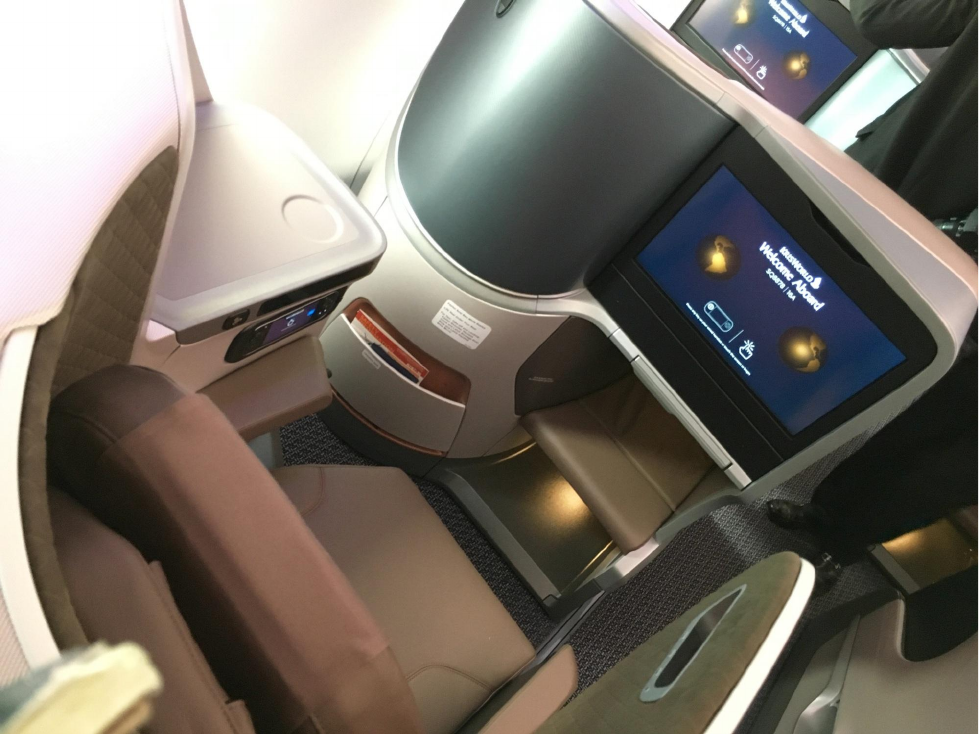
United’s 318-seat 787-10 makes a different choice: 44 Polaris Business Class seats in 1–2–1, 21 Premium Plus seats in 2–3–2, and 253 Economy seats in 3–3–3. Polaris provides a flat bed and direct aisle access. Premium Plus is a separate, wider reclining seat: United lists 19-inch width and 38-inch pitch, against Economy’s 17.3-inch width and 31-inch pitch. The 54 Economy Plus seats remain Economy, with extra legroom; they aren’t another Premium Economy cabin.

ANA’s 294-seat international 787-10 has 38 Business Class seats, 21 Premium Economy seats and 235 Economy seats. Business is staggered 1–2–1 with fully flat beds and direct aisle access. Premium Economy is 2–3–2, with 38-inch pitch; most Economy rows are 3–3–3. This is specifically the international layout. ANA also has a 429-seat domestic 787-10 with 28 Premium Class seats and 401 Economy seats, a very different product that shouldn’t be confused with this comparison.

Singapore Airlines fits 19 more seats than United and 43 more than ANA’s international layout. United, meanwhile, offers eight more Business seats than Singapore Airlines and a separate Premium Economy cabin. Those totals reflect the whole cabin design, including space allocated to seats and facilities. They don’t establish that every seat on the lower-density aircraft is wider or more comfortable.
For Malaysia Airlines, the important question is what the three classes actually buy. A genuinely separate Premium Economy seat would offer a different decision from paying for extra legroom in Economy. The 319-seat total alone establishes neither, and a number close to United’s doesn’t imply a similar cabin.
What Changes for Cash and Enrich Bookings?
For a Malaysian paying cash, nothing bookable changes with this announcement. When the aircraft eventually goes on sale, I’d compare the actual seat, fare and departure time together. A bed could justify more on an overnight flight; a comfortable daytime Economy flight could remain the better buy. A new aircraft on an inconvenient schedule doesn’t automatically win that comparison.
For Enrich members, more seats on the aircraft and more seats offered at an attractive redemption price are separate things. MAG hasn’t announced any changes to award access. A 319-seat aircraft tells us nothing about how many Business seats Malaysia Airlines will install, release for points, or price attractively. I’d look at what two passengers can actually book, including points and cash charges, before treating the fleet announcement as a reason to accumulate more Enrich Points.
Final Thoughts
I’d be very happy to see the 787-10 turn up on nearby routes such as Bangkok or Singapore, although this is very likely to be wishful thinking on my part.
There’s nothing particularly odd about putting a widebody on a short flight. Singapore Airlines already flies its 787-10 to Bangkok and Ho Chi Minh City, while Thai Airways uses widebodies on regional services such as Bangkok–Singapore. For Malaysians, an occasional deployment could offer a welcome chance to experience the new cabin on a weekend trip.
That said, with the Boeing 737-8 serving as Malaysia Airlines’ regional workhorse, I’d expect those appearances to be selective. The Dreamliners will have plenty of longer flights to cover as the A350s retire. Where demand justifies 319 seats, or a regional rotation fits sensibly between longer services, I’d certainly welcome one. I just wouldn’t assume the order means a wholesale upgrade to the short-haul network.
The bigger prize remains what Malaysia Airlines does with the additional flexibility: more useful departure times, worthwhile nonstop choices and cabins that justify their asking price. A comfortable new aircraft would be welcome on any route.
For someone paying cash or redeeming Enrich Points, though, the real improvement comes when it makes the trip they actually want to take a better purchase.


Comments