

Brilliant: JAL to Upgrade B787-9 Aircraft with New Business Class Suites

This is excellent news for anyone who loves Japan Airlines.
As first reported by Executive Traveller, Japan Airlines is planning to upgrade its Boeing 787-9 fleet with new Business Class suites inspired by the same doored suites currently found on its flagship Airbus A350-1000 aircraft. More specifically, the new suites are expected to appear on 11 existing B787-9 aircraft, alongside 10 factory-fresh Dreamliners due between 2028 and 2031.
If you’ve followed Refined Points for a while, you’ll know I previously flew Japan Airlines’ new A350-1000 Business Class from Tokyo to London, and I still consider it one of the most impressive Business Class products in the world today.
So yes, I’m genuinely excited about this.
This isn’t just a minor seat refresh. This is JAL taking one of its best cabin products and making it more scalable across the fleet. For an airline that already excels in service, food, consistency, and general Japanese attention to detail, better hard product consistency is exactly what it needs.
About the New Suites
JAL’s current A350-1000 Business Class is a massive step up from its older long-haul Business Class seats. I won't talk too much about these given that I already wrote a full review here.
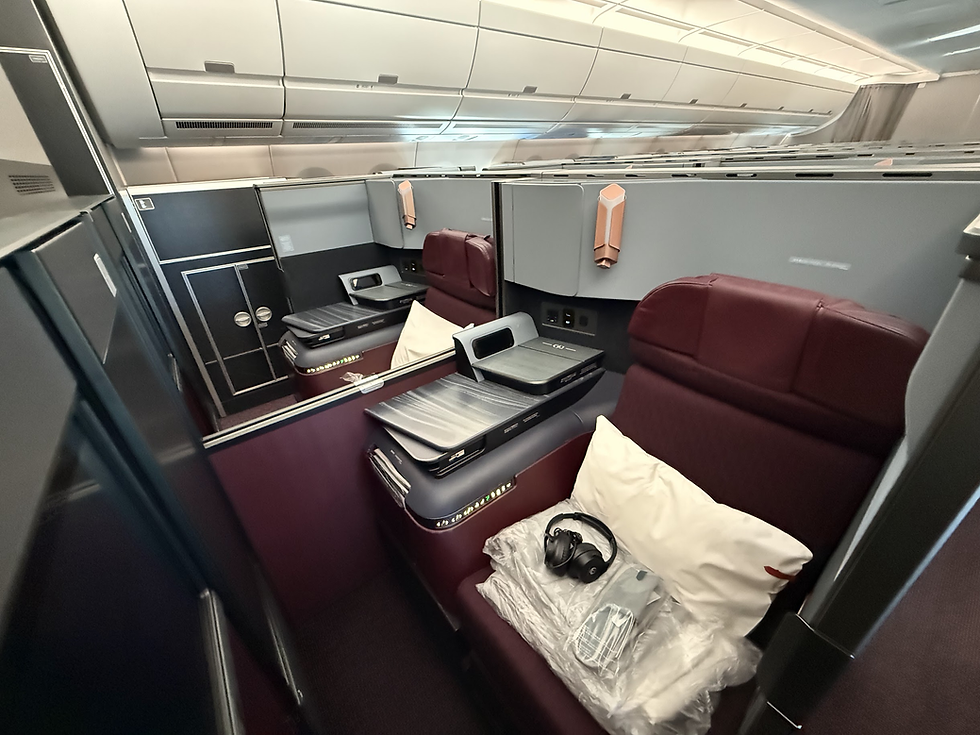
You get direct aisle access, sliding doors, a proper suite-like feel, a huge 24-inch 4K screen, built-in headrest speakers, wireless charging, strong storage options, and a cabin design that feels more thoughtful than flashy.

JAL’s official A350-1000 Business Class page describes the seat as a private space with translucent panel doors, headrest-mounted speakers, wireless charging, and a 1-2-1 layout with 54 Business Class seats.

In my own experience, the most impressive part of the seat wasn’t just the door. Plenty of airlines have doors now. The real brilliance was how refined everything felt. The seat felt private without feeling claustrophobic, the finishings felt restrained and premium, and the headrest speakers were far more useful than I expected.

According to Executive Traveller, the 787-9 version will be similar to the A350-1000 product, though not necessarily 100% identical. That makes sense, given the B787-9 has a slightly narrower cabin than the A350-1000. The same report also notes that the personal wardrobe may not necessarily make it across to the Dreamliner version, which would be understandable if space becomes a constraint.
Even then, this is still a major upgrade.
JAL’s existing B787-9 Business Class seats are not bad. In fact, some configurations are still perfectly competitive, especially the Apex-style JAL Sky Suite seats which offer direct aisle access despite the 2-2-2 layout. But the reality is simple: the premium travel market has moved on.

My previous experience on the 1-2-1 reverse herringbone layout wasn't exactly poor either, although I'd argue Cathay Pacific does a much better job.
JAL’s B787-9 Routes
The million-yen question is whether Kuala Lumpur, Singapore, or Bangkok will see these upgraded B787-9 aircraft. Assuming Singapore or Bangkok do get these seats eventually, a repositioning flight is absolutely on the cards.
At the time of writing, JAL’s Southeast Asia schedule for the March 29 to October 24, 2026 period includes daily Kuala Lumpur-Narita flights, three daily Singapore-Tokyo flights, and multiple daily Bangkok-Tokyo/Kansai flights.
However, aircraft deployment is where we need to be careful. Recent live flight data for JL723/JL724 between Narita and Kuala Lumpur shows the route being operated by the Boeing 787-8 rather than the 787-9. That is slightly disappointing, because KUL has historically seen the 787-9 before, but at least based on the current data point, Malaysians should not assume that Kuala Lumpur will automatically receive the new suites first.
Singapore looks far more promising. Recent live data shows JL036 from Singapore to Haneda being operated by the Boeing 787-9, and this is particularly relevant because positioning from Kuala Lumpur to Singapore is extremely easy.
Bangkok also looks promising. Recent live data shows JL032 from Bangkok to Haneda being operated by the Boeing 787-9, which means Malaysian travellers could realistically access the new product via Bangkok if JAL eventually assigns the refurbished aircraft there.

Not to mention, given that Bangkok Survarnabhumi Airport is one of the very few airports which has a JAL Sakura Lounge, I'd bet on the fact that Bangkok would be a key destination market for the new B787-9 seats.
My realistic take? The first refurbished B787-9 aircraft will probably be prioritised for premium long-haul routes before anything else. That likely means North America, Europe, Australia, or other high-yield routes where JAL can actually monetise the upgraded product properly, so as long as the B787-89 can actually fly these routes.
That said, Singapore and Bangkok are absolutely worth watching.
For Malaysians, this means the easiest way to try the new JAL B787-9 Business Class suites may not be from Kuala Lumpur initially. It may be through a simple positioning flight to Singapore or Bangkok, followed by a JAL flight to Tokyo.
And honestly, that is not the worst outcome.
A short hop to Singapore or Bangkok is far easier than flying all the way to London or New York just to try the A350-1000. If JAL eventually deploys the upgraded 787-9 on Singapore or Bangkok routes, this could become one of the most accessible ways for Malaysians to experience JAL’s newest Business Class suite.
Which Credit Cards in Malaysia Offer Conversions to JAL?
At this point in time, the two most relevant Malaysian banks offering direct conversions to JAL Mileage Bank are CIMB and HSBC.
CIMB Bonus Points can be converted directly to JAL Mileage Bank, and JAL itself lists CIMB as a points transfer partner. The downside is that JAL sits in CIMB’s more expensive conversion tier, requiring 100,000 Bonus Points for 5,000 JAL miles, compared to 75,000 Bonus Points for 5,000 KrisFlyer miles or Avios with many other partners.
Still, if your goal is specifically to earn JAL miles in Malaysia, CIMB is probably the cleaner option.
HSBC also offers JAL Mileage Bank transfers, but I would not build a JAL strategy around HSBC unless you already hold a large stash of HSBC points and have no better use for them, especially since the existing HSBC Premier credit cards are overly restrictive in terms of points capping.
In plain English: yes, HSBC technically gives you a route to JAL miles. No, I would not call it a good one.
Final Thoughts
This is a brilliant move by Japan Airlines.
The A350-1000 Business Class suite is genuinely excellent, and seeing JAL bring a similar product to the B787-9 makes complete strategic sense. The 787-9 is a workhorse aircraft, and if JAL wants to offer a more consistent premium experience across its international network, this is exactly the aircraft to upgrade.
For Malaysian travellers, the route situation is worth watching closely.
Kuala Lumpur would obviously be the dream, but current aircraft deployment does not suggest that KUL is the strongest candidate for the new suites in the near term. Singapore and Bangkok look far more realistic, and both are easy enough for Malaysians to position to if the product becomes compelling enough.
The bigger issue is miles access.
JAL Mileage Bank is still not the easiest programme to earn in Malaysia. CIMB is the best direct route, but the conversion rate is not particularly generous. HSBC exists as an option, but the redemption economics are just ridiculous at best, especially if you foolishly hold the HSBC TravelOne Mastercard.
Still, I’m very happy to see this development.
Between Cathay Pacific’s Aria Suite, Singapore Airlines’ upcoming cabin refresh, and now JAL expanding its doored Business Class suite beyond the A350-1000, premium travel within Asia is becoming genuinely exciting again.


What’s your thought on JAL’s business class vs. ANA’s The Room?